March 7, 2026
Growth in field service businesses usually feels incredible at the start, as more calls are coming in every day, new customers are booking services regularly, and cash flow increases.
For many pest control business owners, this early growth feels like clear proof that the long hours, the tough days, and the constant problem-solving were worth it, as your phone rings more often, your technicians stay fully booked with pest control inspections, and your business name slowly starts getting recognized in your local area.
However, after a certain point, that same growth stops feeling exciting and slowly becomes stressful and overwhelming with huge customer demand and a lack of a centralized system to handle client service calls.
Therefore, you need pest control management software to make your business easier and reduce costs while managing the scheduling process, office operations, client relationships, and tracking real-time data.
Pest Control Software for Growing Businesses That Want Control at Scale
In the early days of a pest control business, operations usually run on simple, familiar tools. Most owners of small businesses depend on phone calls to book jobs, paper diaries or notebooks to plan the day, WhatsApp messages to talk to technicians, basic Excel sheets to track customers, and often their own memory to manage everything.
A pest control business software helps you manage the customer lifecycle with customer relationship management tools and an online portal that offers flexibility for getting paid faster and streamlining both commercial and residential accounts.
In this blog, we will talk about how pest control businesses grow with integrated pest management tools that schedule appointments, send payment reminders, assign jobs, track pest activity, and generate more leads.
Key Takeaway:
- Early growth feels exciting, but without the right systems, it quickly turns into stress, mistakes, and daily hurdles.
- Manual tools like paper schedules, spreadsheets, and constant phone calls cannot scale as a pest control business grows.
- Pest control software creates structure by centralizing scheduling, routing, inventory management, customer data, billing, and communication.
- Better systems allow technicians to complete more jobs each day without working longer hours or feeling overwhelmed.
- Automated communication and recurring service management improve customer experience and retention.
Ready to scale your pest control business with high profit margins and track everything? Book a call with PestBase today.
What is Pest Control Software, and who needs it?
Pest control software is a system designed to help pest control businesses manage their entire pest control operations from a single place, rather than looking for multiple sales tools, spreadsheets, messages, and manual processes every day.
It acts as the central hub of your business, where everything connects and stays organized. With pest control software,
- You can manage job scheduling,
- Assign and dispatch technicians,
- Store and access customer records,
- Handle billing and payments,
- Plan pest control routes and daily workloads, and
- Track pest control reports on Android devices that show how your business is performing.
By 2026, over 65% of pest control companies are expected to use field service software with features designed to automate billing and client communication, highlighting a strong shift toward digital solutions.
Who Pest Control Software Is Built For?
- Owner-operators scaling beyond two or three technicians, where managing schedules, calls, and follow-ups manually becomes stressful and time-consuming.
- Pest control businesses running multiple service routes each day, making it harder to plan jobs, optimize travel time, and keep technicians on track.
- Regional pest control companies handling a high volume of customers and jobs, where visibility, consistency, and efficiency become critical.
Why Growth Breaks Manual Systems in 2026?
1. Scheduling Becomes Hard to Manage
With more customers, scheduling gets more complex. Different service frequencies, tighter time windows, and frequent last-minute changes make manual calendars unreliable. Even a small mistake can lead to missed appointments or double bookings.
2. Technician Coordination Gets Disorganized
Without real-time visibility, owners do not know where pest control operators or technicians are or which jobs are completed or delayed. This leads to constant phone calls between the office staff and the field, wasting time and creating frustration for everyone.
3. Customer Experience Declines
Customers feel the impact when systems fail. Missed reminders, late arrivals, and lack of follow-up result in complaints, poor reviews, and lost trust.
4. Owners Lose Clear Visibility
Manual systems make it hard to track daily jobs, route revenue, and technician performance. Decisions end up being based on guesswork instead of data, which slows down growth and increases stress.
How Pest Control Software Creates Scalable Systems?
Pest control software helps growing businesses move from daily chaos to organized operations. Instead of struggling to manage more customers and technicians, the right software makes growth easier to handle.
1. Centralized Scheduling & Dispatch
All pest control service jobs, technicians, and schedules stay in one place with pest control scheduling software. A live calendar reduces double bookings, missed appointments, and last-minute confusion while offering more flexibility and sending appointment reminders on time.
2. Route Optimization for Faster Service
Route optimization helps the team spend less time driving and more time servicing customers. Better routes with pest control routing software reduce fuel costs, lower stress for technicians, and allow more jobs to be completed each day.
3. Mobile Tools for Field Technicians
Technicians get job details, service history, notes, and updates on their mobile devices. This field service management software helps reduce phone calls, missing paperwork, and delays, while keeping the office updated in real time.
4. Automated Customer Communication
Automatic confirmations, reminders, and follow-ups keep customers informed without manual effort. Clear communication improves customer satisfaction and reduces no-shows.
5. Billing, Invoicing & Payments
Invoices are generated instantly, accept online payments, and recurring services, which are billed automatically. This improves cash flow and removes billing delays.
Key Features Growing Pest Control Businesses Should Look For in 2026
Below are the features that the best pest control software must have to gain high profit margins and deliver unparalleled customer experiences:
| Feature | Why It Matters for Growing Pest Control Businesses |
|---|---|
| Scheduling and Dispatch | Helps avoid double bookings, missed appointments, and last-minute confusion by keeping all jobs and technicians on one shared schedule. It ensures technicians are evenly booked and their time is used efficiently as demand increases. |
| Route Optimization | Reduces unnecessary driving through multiple locations by planning smarter daily routes. This saves fuel costs, lowers travel stress for technicians, and allows more jobs to be completed in a single day without extending work hours. |
| Technician Mobile App | Gives technicians instant access to job details, customer history, service notes, and updates while in the field. This reduces phone calls to the office, cuts paperwork, and helps jobs get completed faster and more accurately. |
| CRM and Customer History | Stores complete customer records, past treatments, and service preferences in one place. This helps teams deliver consistent service, follow up on time, and build long-term customer trust and retention. |
| Recurring Service Management | Automates repeat services like monthly or quarterly pest control plans. This ensures no customer is forgotten, creates predictable revenue, and reduces manual tracking for ongoing contracts. |
| Reporting and Dashboards | Provides clear visibility into daily jobs, revenue, technician performance, and business trends. This helps owners make informed decisions, identify problems early, and plan growth with confidence. |
Real-World Growth Scenario: From Chaos to Control
A. Before Using Business Management Software
- The owner manages schedules using spreadsheets, notebooks, and wall calendars.
- Appointments are written manually, and changes are handled through constant phone calls.
- Sick technicians or weather issues throw the entire schedule off.
- Follow-ups are missed or inconsistent.
- The result is scheduling errors, wasted technician time, and frustrated customers.
B. After Using Pest Control Business Software
- Jobs are scheduled using a simple drag-and-drop system.
- Routes are optimized, allowing 20 to 30 percent more jobs per day.
- Technicians use a mobile app to view job details, upload photos, and sign digitally.
- Customers receive automatic confirmations, reminders, and payment updates through the customer portal.
- Recurring services and invoices run automatically through online payments in just a few clicks.
When Is the Right Time to Invest in the Best Pest Control Software?
I. When Your Team Starts Growing
As soon as your business grows beyond a few technicians or trucks, managing everything manually becomes difficult. Scheduling, routing, and communication take more time and effort, and small mistakes start happening more often.
II. When Scheduling Feels Chaotic
If double bookings, last-minute changes, or daily rescheduling have become normal, it is a clear sign that your current system cannot handle the workload. A packed calendar without structure quickly leads to stress and errors.
III. When Customer Complaints Increase
Missed appointments, unclear arrival times, and poor follow-ups frustrate customers. When you find yourself apologizing often or rebooking services manually, your customer experience is already suffering.
IV. When the Owner Is Stuck in Daily Operations
If the business depends on you to coordinate technicians, fix schedules, and handle problems every day, growth starts to feel like a burden. Scalable software should allow you to step back and focus on growing the business, not running every detail.
V. The Cost of Waiting Too Long
Delaying software adoption leads to lost revenue, technician burnout, and declining customer retention. The longer you wait, the more these small problems add up, making growth harder and more expensive to manage.
VI. Saves Time Across Daily Operations
Pest control software reduces manual work by automating scheduling, dispatch, billing, and communication. This saves time for office staff, technicians, and owners, allowing everyone to focus on more important tasks.
See how pest crm help you get more leads and retain customers here: How CRM Automation Converts More Leads and Retains Customers
Top Pest Control Software Solutions for Growing Businesses
1. PestBase
It is designed specifically for pest control businesses that want powerful systems without complexity. It centralizes scheduling, tech management, customer history, billing, and communication in one platform.
Key Features:
- Drag-and-drop scheduling and smart dispatch: PestBase provides a visual scheduling board where office staff can assign, move, and reschedule jobs instantly.
- Route optimization for efficient daily plans: Route optimization sequences service stops logically based on geography and travel time.
- Mobile technician app with job notes, photos, and e-signatures: The mobile app allows technicians to access job details, customer history, and treatment instructions in the field.
- Automated customer communication (SMS/email reminders, follow-ups): PestBase automates appointment reminders, service confirmations, and post-service follow-ups. Customers receive updates without the office team manually sending texts or emails.
- Billing, invoicing, and recurring service management: The system supports recurring billing for maintenance plans, helping pest control companies manage quarterly or monthly service agreements without manual tracking.
- Real-time performance dashboards: The system supports recurring billing for maintenance plans, helping pest control companies manage quarterly or monthly service agreements without manual tracking.
Pricing:
Typically subscription-based; pricing varies based on business size, number of users/techs, and features chosen (contact vendor for exact quote).
Best For:
Businesses of all sizes that want a single platform designed specifically for pest control operations.
2. PestPac by WorkWave
PestPac is one of the most established pest control software solutions available. It delivers deep pest-specific tools and scalable systems for homeowners, residents, and commercial clients alike.
Key Features:
- Intelligent scheduling and dispatch: Dispatchers can assign jobs based on technician routes, service frequency, contract requirements, and territory rules.
- CRM with customer history and recurring contracts: The built-in CRM stores complete customer profiles, including service history, property details, inspection notes, billing records, and contract terms.
- Compliance tracking and chemical reporting: One of PestPac’s strongest capabilities is regulatory compliance management. The platform tracks chemical usage, application rates, EPA-related documentation, and service records required for audits.
- Performance analytics and business reporting: Offers detailed reporting dashboards that provide insights into revenue, technician productivity, service frequency, chemical usage trends, and contract performance.
- Built-in marketing and communication tools: The system includes integrated communication tools for appointment reminders, renewal notices, and customer outreach campaigns.
Pricing:
Custom quotes based on company size and needs.
Best For:
Larger pest control companies and teams are planning to scale with robust operational tools.
3. FieldRoutes (by ServiceTitan)
FieldRoutes is a well-known cloud pest control solution that supports daily scheduling, routing, and strong mobile access for technicians.
Key Features:
- Route optimization with integrated mapping: FieldRoutes uses built-in mapping and route sequencing tools to automatically arrange service stops in the most efficient order.
- Customer communication tools (texts, emails): The platform includes automated messaging workflows for appointment confirmations, reminders, and service updates. Notifications can be triggered based on job status changes.
- Billing and online payments: FieldRoutes supports digital invoicing and integrated online payment processing. Invoices can be generated automatically once a job is marked complete
- Real-time dashboards and reporting: The system provides operational dashboards that track revenue, technician performance, route efficiency, service completion rates, and customer retention.
- Mobile app with offline access: The app supports offline functionality, allowing techs to continue working in low-connectivity areas.
Pricing:
Custom plans based on features and the number of technicians.
Best For:
Small to medium businesses looking to grow with automation and smart scheduling.
4. Jobber
Jobber is an all-in-one field service software that works well for pest control companies looking for a user-friendly, affordable option. It combines core business tools without overwhelming new users.
Key Features:
- Appointment scheduling and reminders: Jobber includes a centralized scheduling calendar where office staff can assign jobs using a drag-and-drop interface. Appointments can be viewed by day, week, or technician to avoid overlaps and gaps.
- Client management and service history: The platform stores complete customer profiles, including contact information, property details, service notes, and past invoices. Every visit is logged, creating a historical record for recurring pest control services.
- Invoicing and online payments: Invoices can be generated directly from completed jobs without re-entering service details. Line items, taxes, and pricing structures are standardized to reduce billing errors.
- Mobile app for field technicians: The Jobber mobile app allows technicians to access job details, customer history, directions, and notes while in the field. They can update job status, record service details, and capture signatures on-site.
- Quotes and estimates: Jobber enables teams to create structured quotes with predefined services, pricing templates, and optional line items. Quotes can be sent digitally and approved by customers online.
Pricing:
Plans typically start at
- Core: $29/month billed annually
- Connect: $89/month billed annually
- Grow: $149/month billed annually
Best For:
Small teams and owner-operators who want value and simplicity.
5. GorillaDesk
GorillaDesk is a reliable tool that brings scheduling, customer management, and billing under one roof. It is popular with smaller pest control businesses looking for straightforward software.
Key Features:
- Scheduling and dispatch calendar: Technicians can be dispatched based on availability and route order, helping reduce scheduling conflicts and minimizing unnecessary back-and-forth communication between the office and the field.
- Billing and invoicing tools: The platform supports automated invoice generation tied directly to completed service jobs. This reduces manual data entry and ensures invoices reflect actual work performed.
- Customer database and service records: The platform supports automated invoice generation tied directly to completed service jobs. This reduces manual data entry and ensures invoices reflect actual work performed.
- Mobile access for technicians: The mobile app allows field technicians to view schedules, update job statuses, capture notes, and collect payments directly from the field.
Pricing:
Typically around $49–$149/month, depending on features and user count.
Best For:
Small and growing businesses on a budget.
ROI of Pest Control Software: Time, Money, and Growth
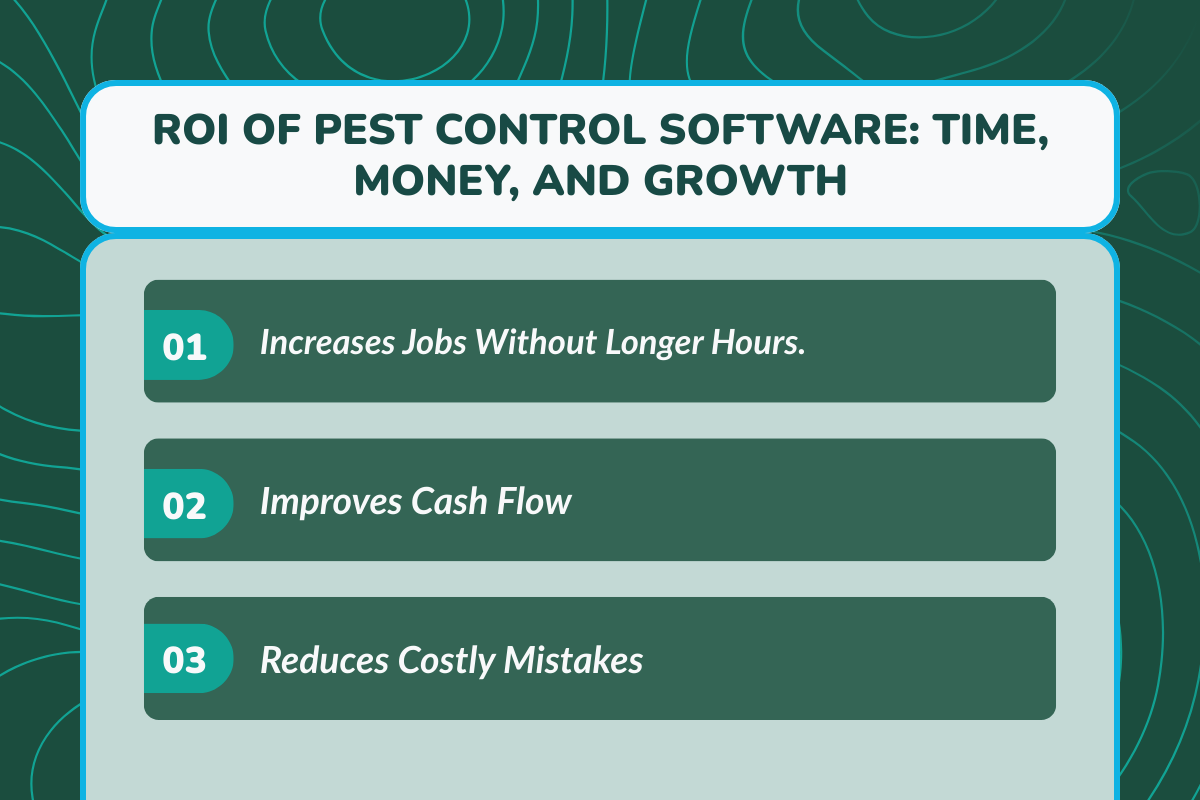
1. Higher Job Capacity Without Increasing Labor Costs
Smarter scheduling, automated dispatching, and route optimization reduce idle time between service calls. When technicians spend less time driving or waiting for instructions, they complete more jobs per day using the same workforce.
2. Faster Cash Flow and Reduced Payment Delays
Automated invoicing, integrated online payments, and recurring billing reduce the lag between job completion and payment collection. Instead of chasing invoices manually, businesses shorten their billing cycle, improve liquidity, and stabilize monthly cash flow, which strengthens operational planning
3. Lower Operational Waste and Fewer Hidden Costs
Manual scheduling errors, missed appointments, duplicate dispatches, and incorrect billing quietly erode margins. A centralized system reduces these inefficiencies by improving visibility and accuracy, lowering rework, customer complaints, and unnecessary fuel or labor costs.
4. Supports Long-Term Growth
By improving efficiency and customer retention, pest control software helps businesses grow steadily without burnout, making growth sustainable and profitable.
Around 58% of pest control businesses generate 70% or more of their revenue from recurring service agreements.
Choosing Between Generic Tools and Pest Control Software: A Simple Checklist
Ask yourself these questions to see which option fits your business better:
- Do you need to manage recurring pest treatments without manual tracking?
- Do you need to store treatment history and compliance records in one place?
- Do you run monthly or quarterly service contracts that must never be missed?
- Do your technicians work on fixed routes that need smart planning?
- Do you want software that fits pest control workflows without workarounds?
If most of your answers are yes, generic field service tools will feel limiting very quickly.
Pest control software is designed to handle these needs from day one, making it easier to stay compliant, serve customers better, and scale your business without adding complexity.
Conclusion: Get Ready for More Signed Contracts through Pest Service Software
Hustle and hard work are what help a pest control business get off the ground, especially in the early days. But as the business grows, relying only on effort and long hours is not enough.
Without the right systems, small mistakes start piling up, daily operations feel overwhelming, and growth becomes stressful rather than rewarding.
This is where pest control software makes a real difference. The right system brings structure to your business by turning messy schedules into clear plans, reducing manual work through automation, and giving you real insight into how your business is performing.
Instead of reacting to problems every day, you can finally run your business with clarity and control. Growth becomes profitable, predictable, and easier to manage.
About PestBase
Pestbase is an all-in-one solution built specifically for growing pest control businesses that need better systems, not more stress. Instead of forcing owners to juggle spreadsheets, calendars, and multiple tools, Pestbase brings scheduling, routing, customer management, billing, and technician workflows into one clean and easy-to-use platform.
It is designed around how pest control businesses actually operate, making daily work simpler for both the office team and field technicians.
If you are ready to take the next step, PestBase is a strong option built specifically for growing pest control businesses. With features like a visual scheduling calendar, automated reminders, and a powerful mobile app for technicians, PestBase helps your team get more done with less confusion. Book a call with PestBase now.
FAQs
1. Is pest control software suitable for small and medium-sized businesses?
Absolutely. Modern pest control software is built to grow alongside your business. Small teams benefit from automation early, while growing businesses gain the structure needed to handle more customers, technicians, and service areas.
2. How does pest control software help with compliance and regulations?
Modern pest control software automatically records chemical usage, service history, safety certifications, and technician activity. This simplifies EPA compliance, audit readiness, and documentation while reducing liability risks caused by manual recordkeeping.
3. Does pest control software integrate with accounting tools?
Yes, most pest control software platforms integrate with accounting tools such as QuickBooks or Xero. These integrations make invoicing, payment tracking, and financial reporting more efficient by reducing manual data entry and minimizing accounting errors.
4. What ROI can growing pest control businesses expect from software?
Businesses commonly see a 25-35% increase in daily job completions and up to 50% faster invoicing. Pest control software boosts technician use, cuts fuel costs, and speeds cash flow, delivering measurable ROI within months.