
OPERATIONS
Pest Control Operations Software Built for Compliant,
Profitable Service Days
Running pest operations is more than dispatching technicians. It's balancing same-day calls against recurring treatments, keeping licenses current, documenting every application, and knowing which return visits you should be billing for.
- Dispatch with confidence: Match each job to technicians qualified by license, service type, skill, and service area.
- Document every treatment: Capture service details, pesticide applications, photos, and customer sign-offs in one auditable record.
- Protect service revenue: Keep recurring treatments, re-services, and renewals active instead of quietly lapsing.
- Run a more profitable operation: Turn technician, route, treatment, and callback data into decisions you can act on.
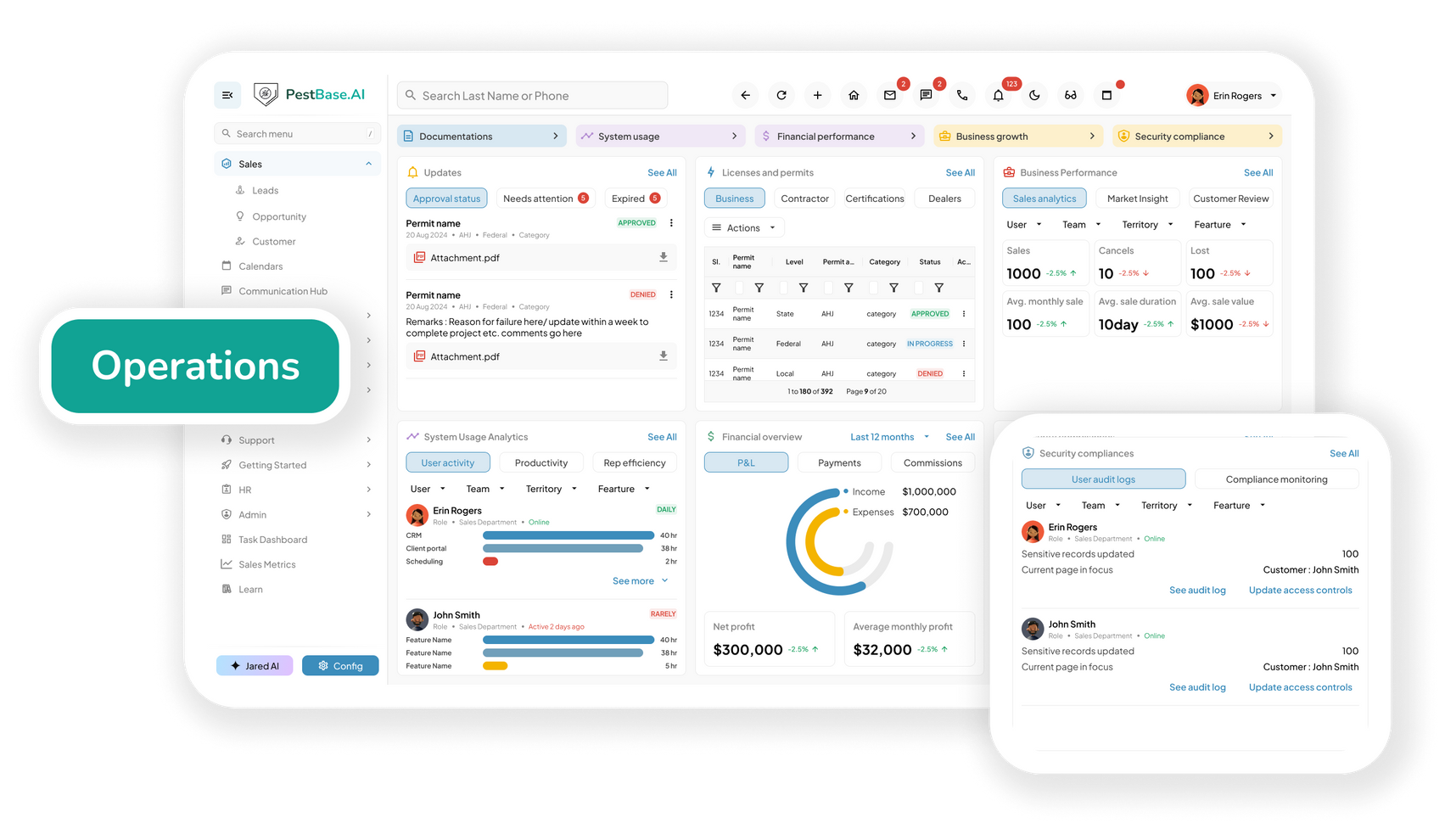
DEFINITION
What is pest control operations software?
Pest control operations software is a system pest management companies use to schedule and dispatch qualified technicians, plan efficient routes, document pesticide applications to meet regulatory requirements, and manage recurring service plans.
What separates it from general field service software is the constraint set: a job can only go to a technician holding the right license category, every application creates a record that must be retained, and the majority of revenue comes from plans that renew rather than jobs that close.
Qualification comes before proximity
A registered technician can perform work under the supervision of a certified applicator, and different service types require different license categories. Sending the nearest available person is only useful if they're allowed to do the job.
- Track certifications against the schedule: License type, category, and expiry held on the technician record and visible when work is assigned.
- Keep supervision relationships visible: Know which registered technicians are working under which certified applicator, and on what.
- Surface expiries before they bite: A license or CEU requirement lapsing mid-season is a dispatch problem before it's an HR one. See technician records.

RETURN VISITS
Not every return visit is a callback
Return visits are where pest margin quietly disappears. A truck goes out, a technician spends an hour, product gets used — and whether that visit was free or billable often isn't recorded anywhere useful.
Warranty callback
Covered under the agreement or guarantee. No revenue, full cost — labor, drive time, and product. High callback rates on one technician, one service type, or one property are a signal worth acting on.
Billable re-service
Additional work outside the agreement or a service the customer requested. Should be invoiced. Recording it as a callback gives away the revenue and distorts your quality metrics at the same time.
Every application, recorded and findable
Product use affects margin on one side and regulatory exposure on the other. Incomplete records are expensive in both directions.
- Capture the record in the field: Product, EPA registration number, quantity, treatment location, and target pest are recorded on the mobile app and synced to the office.
- Follow the label: Keep product labels and Safety Data Sheets available at the job site, including the additional handling that restricted-use products require.
- Search history by property, technician, or service: When a compliance review or a customer question arrives, the answer is a search rather than an afternoon in a filing cabinet.
- Watch product cost against service revenue: Compare material consumption with service activity to spot unusual usage and control cost per job.
Keep the recurring work running
Missed appointments and lapsed plans don't announce themselves. They show up in the annual numbers as a retention problem nobody saw forming.
- Automate the next visit: Recurring plans schedule their own next service against cadence and season, with pause and resume for customers who travel or close for winter.
- Send reminders that reduce no-access visits: SMS and email reminders for upcoming treatments, inspections, and follow-ups, so fewer trucks arrive at empty properties.
- See the day as it actually runs: Live visibility into routes, job status, and progress so a manager can respond to delays, weather, and emergency calls before the schedule collapses.
- Report on what predicts problems: Route efficiency, drive time, completion times, callback rate, and production per technician in one view, so workload gets rebalanced before service quality slips.
Why a general FIELD SERVICE falls short
Pest operations run on constraints other trades don't have
Generic field service platforms optimize for getting a qualified-enough person to a job efficiently. Pest control adds a licensing requirement, a mandatory record, and a return-visit economy on top of that.
| Where it matters | A general field service tool | Pest control operations software |
|---|---|---|
| Dispatch logic | Assigns by proximity or availability | Assigns by licence category and service-type qualification |
| Route planning | Optimised for drive time alone | Balances drive time against service-area authorisation and treatment compatibility |
| Work orders | Generic completed-job checklist | Pesticide application records with EPA registration numbers and treatment detail |
| Technician qualifications | Not tracked | Licence type, category, and expiry held against every assignment |
| Return visits | Logged as ordinary jobs | Warranty callbacks separated from billable re-services, tracked by technician and service type |
| Service quality | Rarely measured | First-time completion tracked by technician, service type, and route |
| Productivity | Count of jobs completed | Production per technician, stops per day, and callback rate together |
| Documentation | Manual or absent | Application, licence, and treatment records retained and searchable for review |
| Reporting | General job-status dashboards | Route efficiency, callback rate, first-time completion, and production in one view |
Comparison is against general-purpose field service software as a category, not any named product.
wHAT CHANGES
Three things that stop going wrong
Unqualified assignments stop happening
License categories and expiry dates sit against the schedule, so work goes to technicians who can legally perform it, and the records are there if anyone asks.
Return visits stop being invisible
Warranty callbacks and billable re-services are separated, so you stop giving away revenue and start seeing which technicians, properties, and treatments generate repeat visits.
Recurring plans stop lapsing quietly
Next visits schedule themselves and renewals surface before expiry, instead of appearing as an attrition number at year-end.
Frequently asked questions
Does dispatch prevent assigning an unqualified technician, or just show their certifications?
Licence categories and expiry dates are held on the technician record and surfaced during assignment so dispatchers can see qualification before allocating work.
How does it tell a callback from a re-service?
The return visit is classified when it's created and confirmed by the technician on completion, so warranty-covered work and billable work stay separate in both the invoicing and the quality reporting.
Can we see which properties generate repeat callbacks?
Yes. Callbacks are tracked by property, technician, pest type, and treatment, which usually points at whether the cause is training, product choice, or conducive conditions at the site that need exclusion work.
Where do leads and sales opportunities live?
On the sales and CRM side, not here. Operations covers scheduling, service delivery, documentation, and recurring plan execution — the same customer record, a different part of the workflow.
Can recurring plans be paused?
Yes. Plans can be paused and resumed for customers who travel or for commercial sites that close seasonally, without cancelling the agreement or losing the renewal date.
What operational reporting is included?
Route efficiency, drive time, first-time completion, callback rate, production per technician, and cost per job — reported by technician, service type, and route.
SERVICE / COMPLETED
Every route compliant, every treatment documented, every callback accounted for
Bring a real service week and we'll show you where the margin is going.
Or call 1-888-678-6227