
INVENTORY
Pest Control Inventory Software for
Products, Equipment, and Compliance
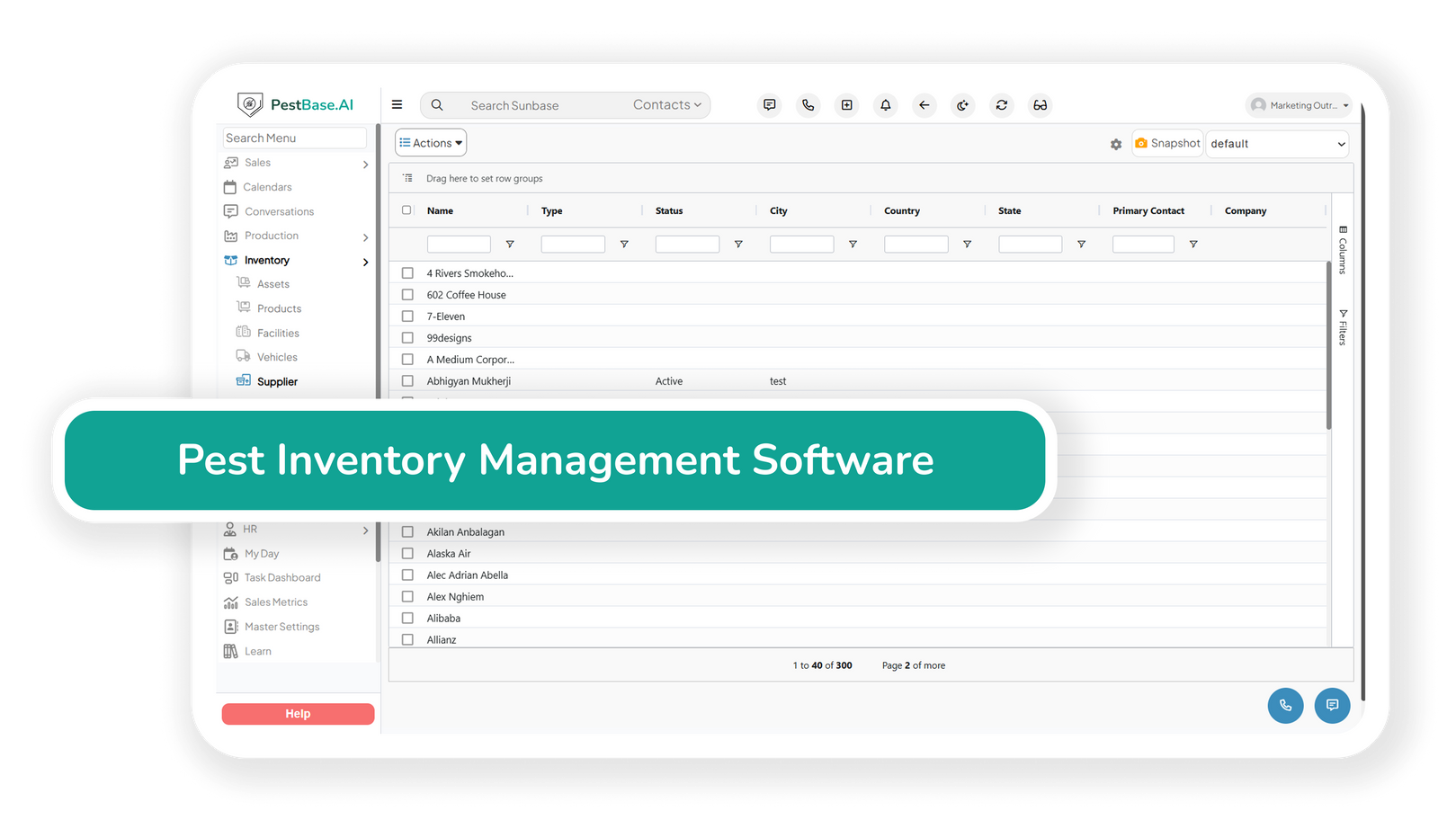
You need to know what's on the truck before you commit a technician to the job. Poor visibility means emergency purchases at retail prices, expired product sitting on a shelf, and service delays you find out about from the customer.
- Track what's where: Pesticides, bait stations, traps, PPE, and equipment across the warehouse and every truck, updated from the field after each service.
- Keep the record with the material: Product details, EPA registration numbers, and approved units of measure held against every item you carry.
- Reorder on real consumption: Purchase orders built from what was actually applied, not from a guess about what's running low.
DEFINITION
What is pest control inventory software?
Pest control inventory software tracks pesticides, baits, traps, equipment, and PPE across a warehouse and a fleet of service vehicles, and records what each technician applies on each job.
It differs from general inventory software in what it has to carry with each item: EPA registration numbers, label rates, dilution instructions, expiry dates, and restricted-use status. In this industry, a stock record and a compliance record are the same record.
Your warehouse has wheels
Most pest inventory isn't in a warehouse. It's spread across a dozen trucks, and each one is a stock location that moves, sells from itself, and restocks on its own schedule.
- Treat every truck as a stock location: Know what each technician is carrying, not just what the warehouse thinks it issued.
- Confirm availability before booking: Office staff can see whether the product a job needs is actually on the assigned truck before the appointment is set. See scheduling.
- Track transfers between locations: Warehouse to truck, truck to truck, and returns — so shrinkage shows up as a question rather than a mystery.

The label is the law, and it travels with the product
Applying a product above its labeled rate is a violation, not a mistake. Technicians work under time pressure across several products a day, and the label is usually a folded sheet in a truck door pocket.
- Label data on the product record: Approved application rates, dilution instructions, and target-pest guidance attached to every product, available before treatment rather than after.
- Flag applications outside approved parameters: An entry that falls outside the configured labeled range is surfaced at the point it's recorded, while the technician is still on site.
- Handle restricted-use products properly: Track restricted-use status, who is certified to apply them, and the purchase and use records those products require.
- Keep Safety Data Sheets with the item: The SDS a technician needs is attached to the product they're carrying.
Expired product is a cost and a violation
Overstocking in this industry doesn't just tie up cash. Product has a shelf life, and applying something past its date is a compliance problem as well as a write-off.
- Track expiry dates and lot numbers: Know what's approaching its date while there's still time to use it on scheduled work.
- Scan instead of typing: Barcode scanning for products, baits, traps, and bait stations, so stock updates happen at the truck rather than at a keyboard later.
- Automate low-stock alerts and reorders: Replenish before a shortage delays a service, without buying ahead into product that will expire on the shelf.
- Build purchase orders from real consumption: Reconcile orders against what was actually applied on jobs, rather than against a standing order nobody has reviewed in a year.
Built for how pest sells
Three things a general CRM can't do
01
Recieve
Log distributor shipments into the warehouse with product details, quantity, and expiry.
02
Stock
Issue to trucks and track transfers, so warehouse and vehicle counts stay live.
03
Apply
Technicians scan and record method, quantity, target pest, and treatment location in the field.
04
Reconcile
Match consumption against scheduled jobs, flag shortages and excess, and trigger replenishment.
05
Report
Produce usage records and product cost reporting directly from the logged field data.
Why a general
inventory tool falls short
A stock record and a compliance record are the same record
General inventory software is built for retail counts and warehouse shelving. It has no reason to know what an EPA registration number is, and no concept of a product whose use is legally constrained by its own label.
| Where it matters | General inventory software | Pest control inventory software |
|---|---|---|
| Product records | Item code and quantity fields | EPA registration number, approved units of measure, restricted-use status, and expiry against every item |
| Label compliance | Not tracked | Labelled rates, dilution instructions, and target-pest guidance attached to the product |
| Application records | No pesticide-specific recordkeeping | Method, quantity, target pest, and EPA number captured to support FIFRA recordkeeping |
| Bait stations | Generic stock counts | Station location, condition, and findings logged per device from the field |
| Stock locations | Warehouse shelving | Warehouse plus every service vehicle, with transfers tracked between them |
| Material movement | Manual stock adjustments | Distributor receipt, warehouse transfer, and technician usage in one traceable trail |
| Purchasing | Disconnected from job costing | Purchase orders reconciled against actual field usage and scheduled job demand |
| Reporting | Quantity counts and valuation | Product cost per service, consumption by technician, and usage records for review |
Comparison is against general-purpose inventory software as a category, not any named product.
wHAT CHANGES
Three things that stop going wrong
No more emergency purchases
Low-stock alerts fire before a shortage reaches the schedule, so you stop buying product at retail prices on the way to a job.
Nothing expires quietly on a shelf
Expiry visibility means the product gets used while it's usable, rather than being written off and disposed of at additional cost.
Product cost stops being a mystery
Consumption ties back to the service that used it, so you can see cost per job and per technician instead of one line in an annual figure.
Frequently asked questions
Can we track stock on individual trucks, not just the warehouse?
Yes. Each service vehicle is treated as its own stock location, with transfers tracked between the warehouse and trucks and between technicians, so you know what's actually on board before a job is assigned.
Does it flag applications outside the labelled rate?
Approved application rates and dilution instructions are held on the product record, and entries falling outside the configured range are surfaced when recorded.
How does this relate to pesticide use records?
They're the same event seen from two sides. When a technician records an application it creates the regulatory record and deducts the product from stock at once. The regulatory side is covered on compliance; this page covers the material side.
Does it handle restricted-use pesticides?
Restricted-use status is held on the product record alongside the certification required to apply it.
Can technicians scan barcodes instead of typing?
Yes. Products, baits, traps, and bait stations can be scanned from the mobile app, which is how stock counts stay accurate on a busy route. See the technician app.
Where does purchasing and cost reporting live?
Purchase orders and consumption are tracked here; margin, job costing, and financial reporting sit on finance. The two share the same underlying usage data.
STOCK / READY
Turn inventory into a compliance and cost-control advantage
Bring a month of product purchases and we'll show you what reconciling them against actual field usage looks like.
Or call 1-888-678-6227