
SALES
Pest Control Sales Software That Turns Inquiries Into
Recurring Service Agreements
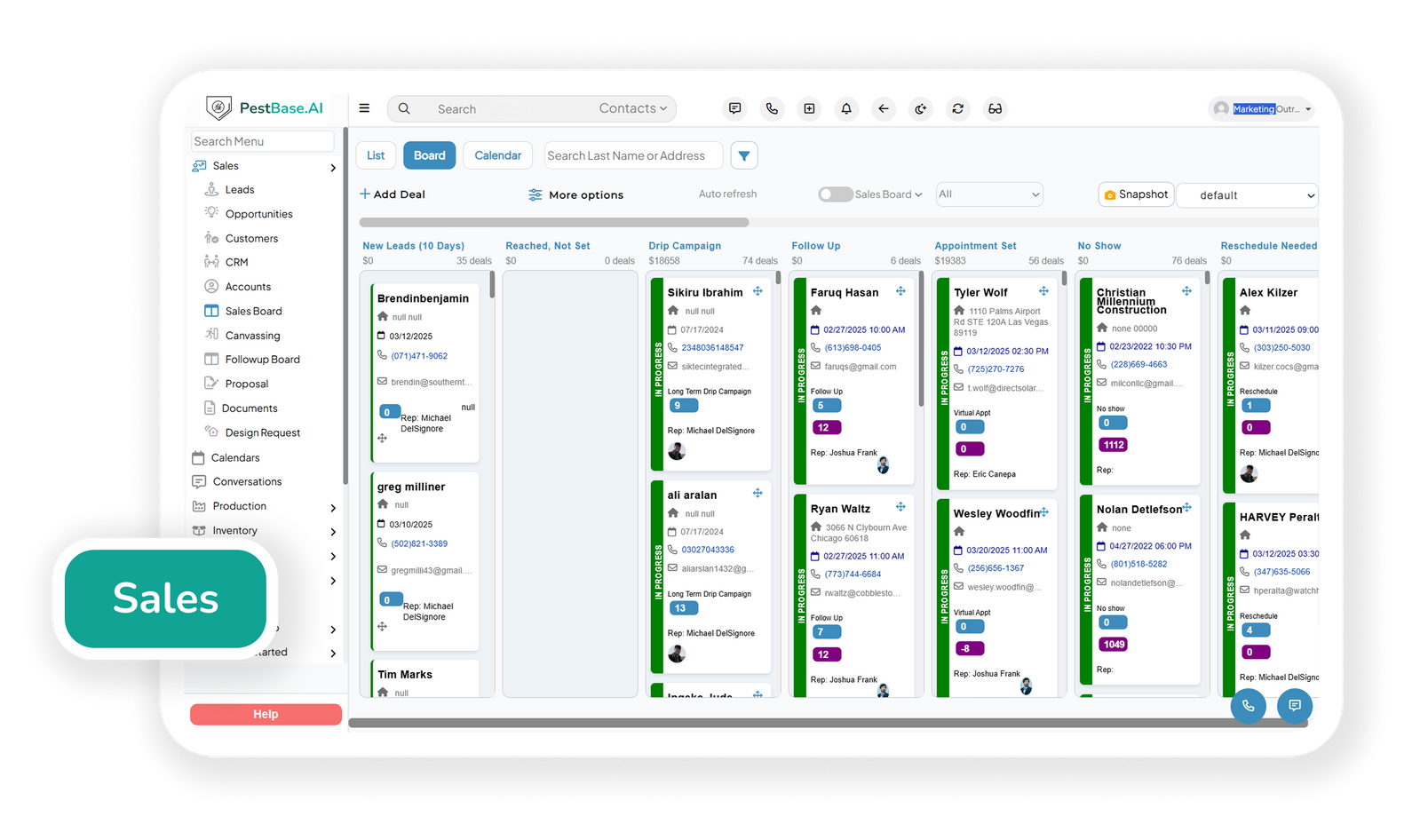
A pest opportunity can start with a homeowner finding ants, a commercial inspection, a door knock, or a technician spotting a second problem on site. All of them should end up in the same pipeline.
- Capture and segment residential, commercial, inspection, and field-generated leads from every source.
- Track each opportunity from first inquiry and inspection through estimate, proposal, and signed agreement.
- Automate follow-ups and scheduling so opportunities keep moving without someone chasing them.
- Keep field technicians, sales reps, and office staff working from one customer record.
- Measure sales performance and forecast recurring revenue on live dashboards.
DEFINITION
What is pest control sales software?
Pest control sales software is a system pest management companies use to manage sales opportunities, automate prospect follow-up, build estimates and proposals, and convert qualified prospects into signed service agreements. Unlike a general-purpose CRM, it accounts for how pest work is actually sold — urgent infestation calls, inspection findings, recurring plans on set intervals, and renewals that carry the majority of the revenue.
Residential: an urgent problem, then an ongoing relationship
A residential inquiry usually starts the day a homeowner finds ants, roaches, mosquitoes, rodents, or termite damage and wants it dealt with now. The one-time treatment is the easy sale. The recurring plan is the valuable one.
- Capture urgent inquiries fast: Someone who has just found droppings in a pantry is calling three companies. The first to respond usually wins the work.
- Match the pest problem to the right plan: Recommend the service package that fits what was actually reported, rather than defaulting to a single offering.
- Keep follow-up consistent: Move from inquiry to estimate to signed agreement without the opportunity stalling in someone's inbox.

Commercial: requirements become recurring contracts
Commercial properties often need recurring service to meet contractual and regulatory requirements. The sale isn't a treatment — it's an ongoing program with documentation attached.
- Connect the inspection to the contract: Proposals, treatment schedules, renewal follow-ups, and field activity all stay on one customer record.
- Capture the record from the first visit: Technicians scan bait stations and log product information, including EPA registration numbers and quantities used, supporting the recordkeeping expected under FIFRA.
- Sell the documentation, not just the service: Commercial buyers are buying audit-ready records as much as treatment — make that part of the proposal.
Your technicians are already standing in the opportunity
The cheapest lead in pest control is the one a technician finds while already at a property. No marketing spend, no drive time, and a customer who already trusts you.
- Log findings as they happen: A technician spotting a second infestation, a conducive condition, or an unprotected structure records it on the spot rather than mentioning it back at the shop.
- Route it to sales automatically: The finding becomes a tracked opportunity instead of a note that depends on someone remembering to pass it on.
- Turn it into an upgrade or an add-on: Exclusion work, a second structure, or a step up from general pest to a termite plan — the upsells that lift account value without adding a customer.

Why a general CRM falls short
A pest sale isn't a standard sales cycle
General CRMs are built for a linear pipeline that ends at a closed deal. In pest control, the close is the beginning; the lead often comes from your own technician, and the revenue lives in the renewal.
| Where it matters | A general CRM | Pest control sales software |
|---|---|---|
| Lead sources | Standard marketing channels | Homeowner inquiries, commercial prospects, referrals, inspections, and technician-found work in one pipeline |
| Urgent inquiries | Treated like any other lead | Problem-driven calls prioritised, because a live infestation doesn't wait for a nurture sequence |
| Inspection to sale | Inspection and sales activity stay separate | Findings connect directly to the estimate, proposal, and follow-up |
| Technician-found work | Needs a manual handoff to sales | Opportunities discovered on a service visit enter the pipeline automatically |
| Estimating | Generic quote creation | Priced on property size, structure, target pest, and service frequency |
| Recurring agreements | Marks the deal won and moves on | Manages monthly, bi-monthly, quarterly, and annual plans as ongoing revenue |
| Renewals | Another generic sales task | Tracked against plan and termite bond anniversary dates before they lapse |
| Service history | Sales and service data often disconnected | Treatment history stays attached to the property, informing the next sale |
| Pipeline visibility | Deal stages and totals | Inquiries, inspections, estimates, proposals, agreements, and what needs following up |
Comparison is against general-purpose CRM software as a category, not any named product.
Built for how pest sells
Three things a general CRM can't do
01 / RECORD
Recurring plan management
Set up monthly, quarterly, or seasonal plans, link them to the customer agreement, and manage renewals so recurring revenue keeps running rather than quietly lapsing.
02 / RECORD
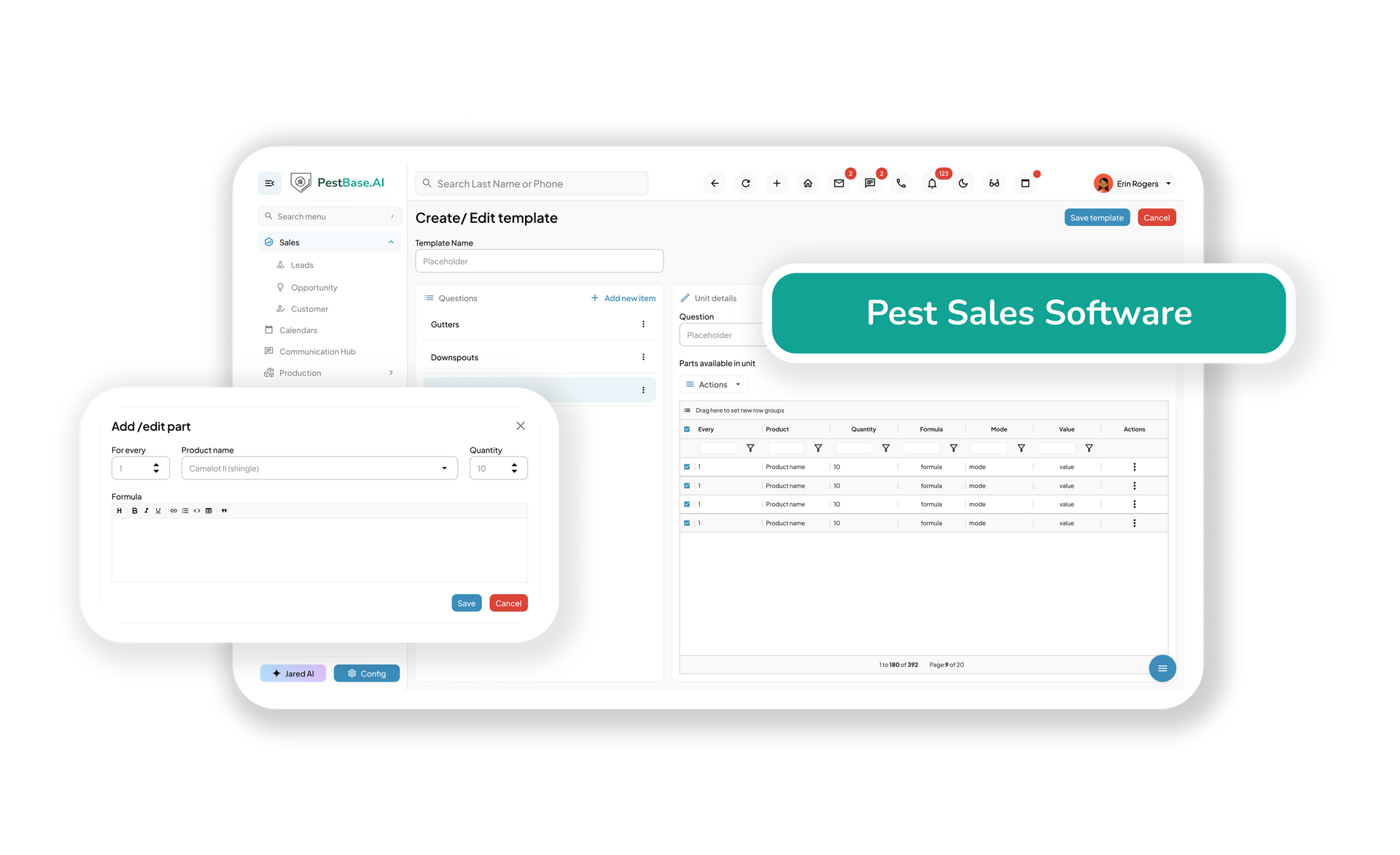
Pest-specific estimating
Build estimates from property size, pest activity, treatment requirements, and service frequency instead of a generic line-item quote.
03 / RECORD
Margin visibility per agreement
A signed termite agreement can look profitable and still lose money through labor, product cost, and warranty callbacks. Connect job costs and invoices to the sale so profitability shows while the work is live, not at month-end.
wHAT CHANGES
Three things that stop going wrong
Opportunities stop disappearing
Inquiries, inspection findings, and technician-found work stay visible in one place, with automated follow-up so a prospect isn't lost to whoever called back first.
You learn what actually sells
Live dashboards show which lead sources, services, and campaigns produce recurring customers rather than one-off jobs, so spend follows what works. See marketing tools.
Renewals stay renewed
The opportunity stays connected to the agreement after the close, and renewal follow-ups run on schedule instead of surfacing when the annual numbers come in.
Frequently asked questions
Can we sell both one-time treatments and recurring plans from the same pipeline?
Yes. Both run through the same opportunity stages, and a one-time treatment can be converted to a recurring plan without re-entering the customer or the property.
How do technician-found opportunities reach the sales team?
A technician logs the finding in the app during the visit and it becomes a tracked opportunity on the customer record, rather than a note that has to be passed on verbally. See the technician app.
Does it handle commercial sales differently from residential?
Yes. Commercial opportunities carry inspection findings, treatment schedules, and service documentation through to the contract, because commercial buyers are evaluating records as much as treatment.
Can we forecast recurring revenue?
Dashboards report on pipeline value, sales activity, renewal rates, and recurring plan performance, so forecasting is based on active agreements rather than closed-deal totals.
Do we still need a separate CRM?
No. Leads, opportunities, customers, properties, agreements, and service history sit on the same system as scheduling and billing, so nothing is exported between a sales tool and an operations tool. See lead capture and CRM.
How does it help with seasonal demand?
Lead source and conversion reporting is available by period, so you can see which campaigns and services performed during termite swarm season or the summer mosquito peak and plan the next one against real numbers.
AGREEMENT / SIGNED
Turn more pest opportunities into signed recurring agreements
Bring a month of real inquiries and we'll show you where they stall and what closes the gap.
Or call 1-888-678-6227