
MARKETING
Pest Control Marketing Software That Keeps the
Schedule Full Year-Round
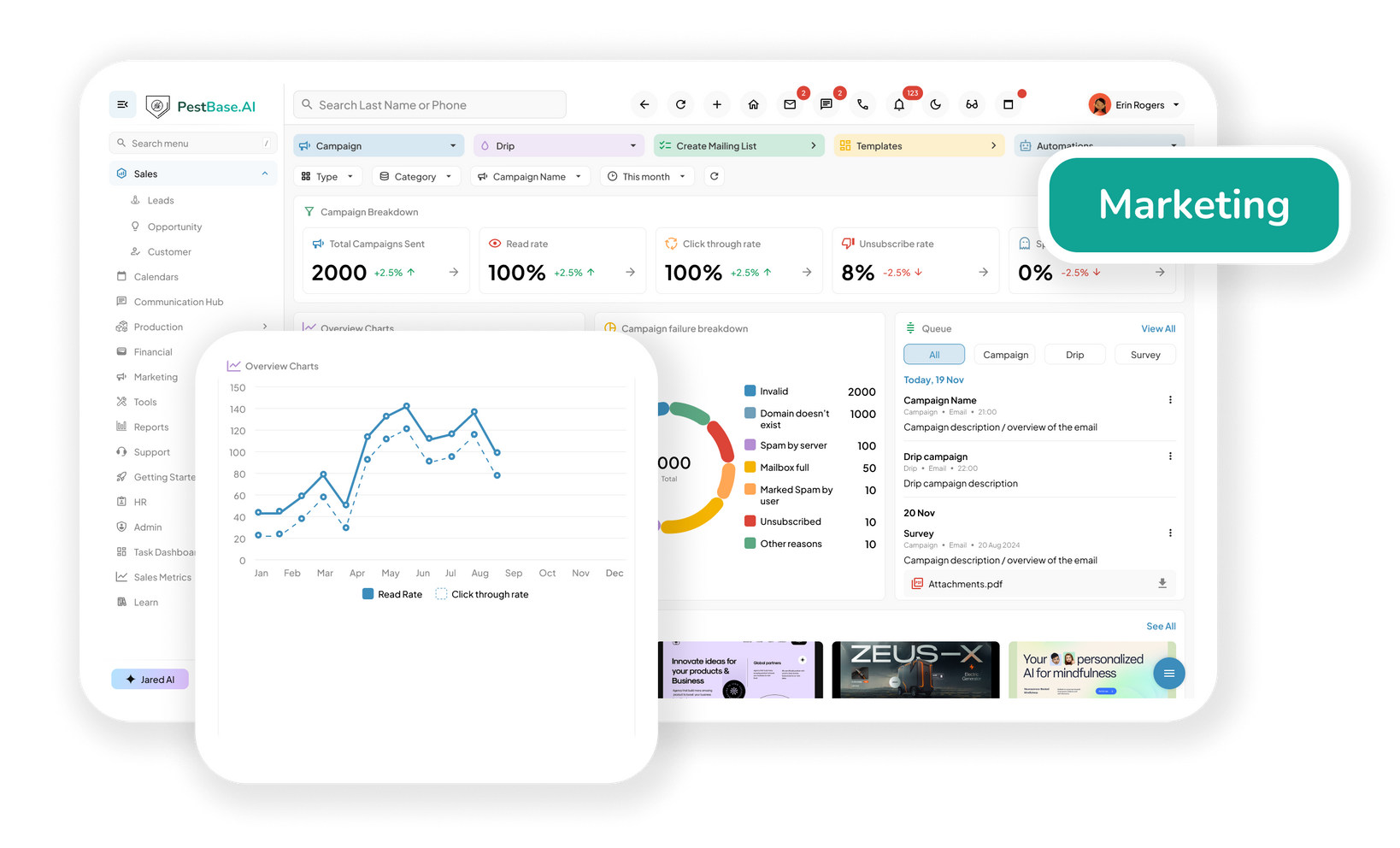
Pest demand arrives in waves and disappears between them. Marketing built for this business works the peaks hard, fills the troughs with recurring plans, and tells you which channels produced booked jobs rather than clicks.
- Capture residential, commercial, seasonal, and referral-driven interest from every channel in one place.
- Track impressions, click-throughs, leads, and conversions through to the booked job — not just the form fill.
- Trigger seasonal offers, renewal reminders, review requests, and re-engagement campaigns automatically.
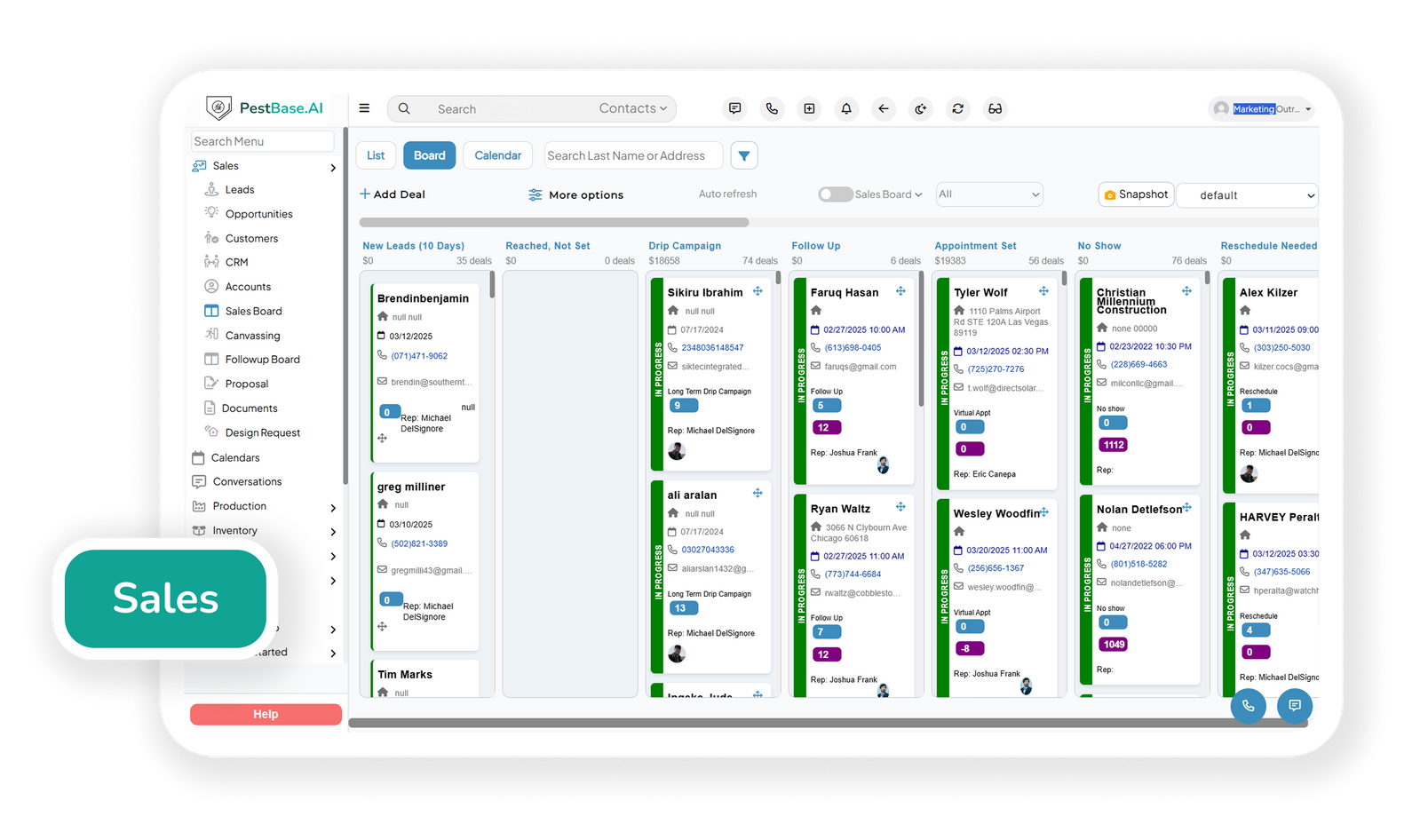
- Keep office sales teams and door-to-door canvassers working from the same customer record.
DEFINITION
What is pest control marekting software?
Pest control marketing software is a system pest management companies use to generate and manage leads, run seasonal and retention campaigns, collect reviews and referrals, and measure which marketing activity turns into booked services. Unlike general marketing tools, it accounts for seasonal pest pressure, service-area targeting, and recurring service agreements — where most of the revenue in this industry actually sits.
Market to the season, not the calendar
Pest demand is driven by weather and biology, not by quarters. Spring brings termite swarms, summer loads mosquito and ant volume, and the first cold snap starts the rodent calls.
- Time campaigns to local pest pressure: Regional and seasonal activity varies enormously between markets. A mosquito campaign that works in Florida in March is early by two months in Michigan.
- Target areas with conducive conditions: Identify neighborhoods with high service potential and align paid campaigns and canvassing territories to them. See canvassing.
- Fill the quiet months with recurring plans: The point of a recurring plan is that it bills in February as well as July. Off-season campaigns should sell the plan, not the treatment.

Most pest jobs start with someone searching nearby
A homeowner who finds carpenter ants searches "exterminator near me," picks from the first few local results, and calls two or three. Local visibility isn't one channel among many in this business — it's the front door.
- Feed reviews into local visibility: Review volume and recency influence local ranking. Automating requests after every completed service keeps that flow steady instead of arriving in bursts.
- Track calls and forms by service area: Know which towns and postcodes produce booked work, so ad spend and canvassing follow the map rather than the whole metro.
- Respond fast enough to win the call: Someone comparing three local companies usually books the first one that answers, which makes response time a marketing metric as much as an operations one.
- Connect the search to the signed plan: Attribution that stops at the phone call can't tell you whether a channel produces one-off treatments or recurring customers.
Commercial marketing sells documentation, not treatment
A facility manager isn't buying because they saw a roach. They're buying because an audit is coming and they need a program with records behind it. That's a different message and a much longer decision cycle.
- Speak to the actual buyer: Facility managers, property management companies, and food-service operators respond to compliance, documentation, and reliability — not urgency.
- Nurture longer B2B cycles: A commercial contract can take months. Campaigns need to stay warm across that span without a rep manually checking in.
- Connect early outreach to the contract: Track the campaign that started the conversation through to the proposal and the signed agreement, so commercial spend can be judged on contracts rather than inquiries.
A completed service is your cheapest marketing asset
The moment a technician closes a job is the moment a customer is most willing to leave a review or pass on a neighbor's name. It's also the moment nobody has time to ask.
- Request reviews automatically on completion: Triggered when the technician marks the service done in the app, so the ask lands while the visit is still fresh. See the technician app.
- Send referral links and track who sent whom: Attribute new business back to the customer who referred it, which is the only way to know who your actual advocates are.
- Recognize your top referrers: Targeted offers to customers who consistently send work, rather than blanket discounts to everyone.
Why a general marketing tool falls short
Pest marketing isn't a standard funnel
General marketing platforms assume steady demand and a one-off purchase. Demand spikes with the weather; the buyer is often urgent, and the goal is a plan that renews rather than a sale that closes.
| Where it matters | A general marketing tool | Pest control marketing software |
|---|---|---|
| Lead sources | Standard marketing channels | Local search, paid ads, seasonal demand, referrals, reviews, and field-generated leads together |
| Urgent demand | Treats every enquiry the same | Prioritises time-sensitive infestation calls, which convert on speed rather than nurture |
| Seasonality | No pest-specific seasonal data | Campaigns timed to regional pest pressure rather than a fixed marketing calendar |
| Campaign to job | Marketing and sales data often separate | Connects the campaign source to the enquiry, estimate, and signed agreement |
| Reviews & referrals | Manual or generic requests | Triggered off completed service visits, with referrals attributed to the referring customer |
| Commercial campaigns | One message for everyone | Compliance-led messaging for facility managers on longer decision cycles |
| Local visibility | General SEO and ad tooling | Built around service-area search intent, where most residential demand starts |
| Re-engagement | Generic remarketing to lapsed leads | Reflects seasonal return and lapsed recurring plans worth reactivating |
| Attribution | Measures clicks and leads | Reports cost per booked job and revenue from recurring agreements, not form fills |
Comparison is against general-purpose marketing software as a category, not any named product.
ATTRIBITION
Cost per lead is the wrong number
A channel producing cheap leads that never book is more expensive than an expensive channel that fills routes. The only figures worth managing against are the ones downstream of the form fill.
- Cost per booked job, not cost per lead: See which channels produce work that actually gets scheduled and performed.
- Recurring versus one-off by source: A channel that sells quarterly plans is worth several times one that sells single treatments, even at the same lead cost.
- Find the expensive channels early: Identify sources with high acquisition cost and low conversion into booked services, and move the budget before the season ends.
wHAT CHANGES
Three things that stop going wrong
Leads stop leaking
Every marketing-generated inquiry lands in one place with automated follow-up, so nothing is overlooked, delayed, or lost to whoever called back first.
Budget follows results
Channel performance is measured on booked jobs and recurring agreements, so spend moves toward what produces customers rather than what produces traffic.
Quiet months get quieter money
Re-engagement and renewal campaigns keep recurring revenue running through the off-season, when there's no seasonal demand to carry the schedule.
Frequently asked questions
How is this different from the CRM?
Marketing generates demand and tells you which sources produced it. The CRM manages each lead once it arrives — stages, follow-up, and conversion. They run on the same customer record, so a campaign source stays attached to the account through to the signed agreement.
Can we time campaigns to local pest seasons?
Campaigns can be scheduled and targeted by service area, so you can align them to the pest pressure in each market you serve rather than running one national calendar.
Are review requests automatic?
Yes. They trigger when a technician marks the service complete in the app, so the request goes out while the visit is fresh rather than in a weekly batch.
Can we see which lead sources produce recurring customers?
Yes. Attribution follows the lead through to the booked job and the signed agreement, so a source can be judged on recurring revenue rather than on lead volume.
Does it help with marketing materials for canvassing?
Branded templates are available for print and digital materials used by field teams.
Can we run campaigns to lapsed customers?
Yes. Customers whose plans lapsed or who cancelled can be segmented and targeted for reactivation, using the service history already on the record.
CAMPAIGN / CONVERTED
Turn marketing spend into booked jobs and recurring plans
Bring last season's channel numbers and we'll show you what attribution through to the signed agreement looks like.
Or call 1-888-678-6227