
Invoicing & Payments
Pest Control Invoicing Software That Keeps Recurring Revenue Collected
Invoice the moment a service closes, run recurring plan billing on autopay, chase what doesn't clear, and hand your accountant clean ledger data instead of a spreadsheet.
One-time treatments · Recurring plans · Termite bond renewals · Commercial accounts on net terms
9:25 AM · The first job closes
Batching invoices weekly means every service waits an average of three days before anyone asks to be paid for it. Across a few hundred visits a month, that gap is a real number.
The invoice writes itself when the job closes
Batching invoices weekly means every service waits an average of three days before anyone asks to be paid for it. Across a few hundred visits a month, that gap is a real number.
- Generate the invoice automatically from the completed service, with customer, property, and service details already filled in.
- Bill from what the technician actually recorded — services performed, materials used, add-ons sold — rather than from a separate re-entry that introduces errors.
- Send it the same day, or let the technician deliver it before leaving the property.
- Use branded invoice templates so what arrives in a customer's inbox looks like it came from a company rather than a spreadsheet.
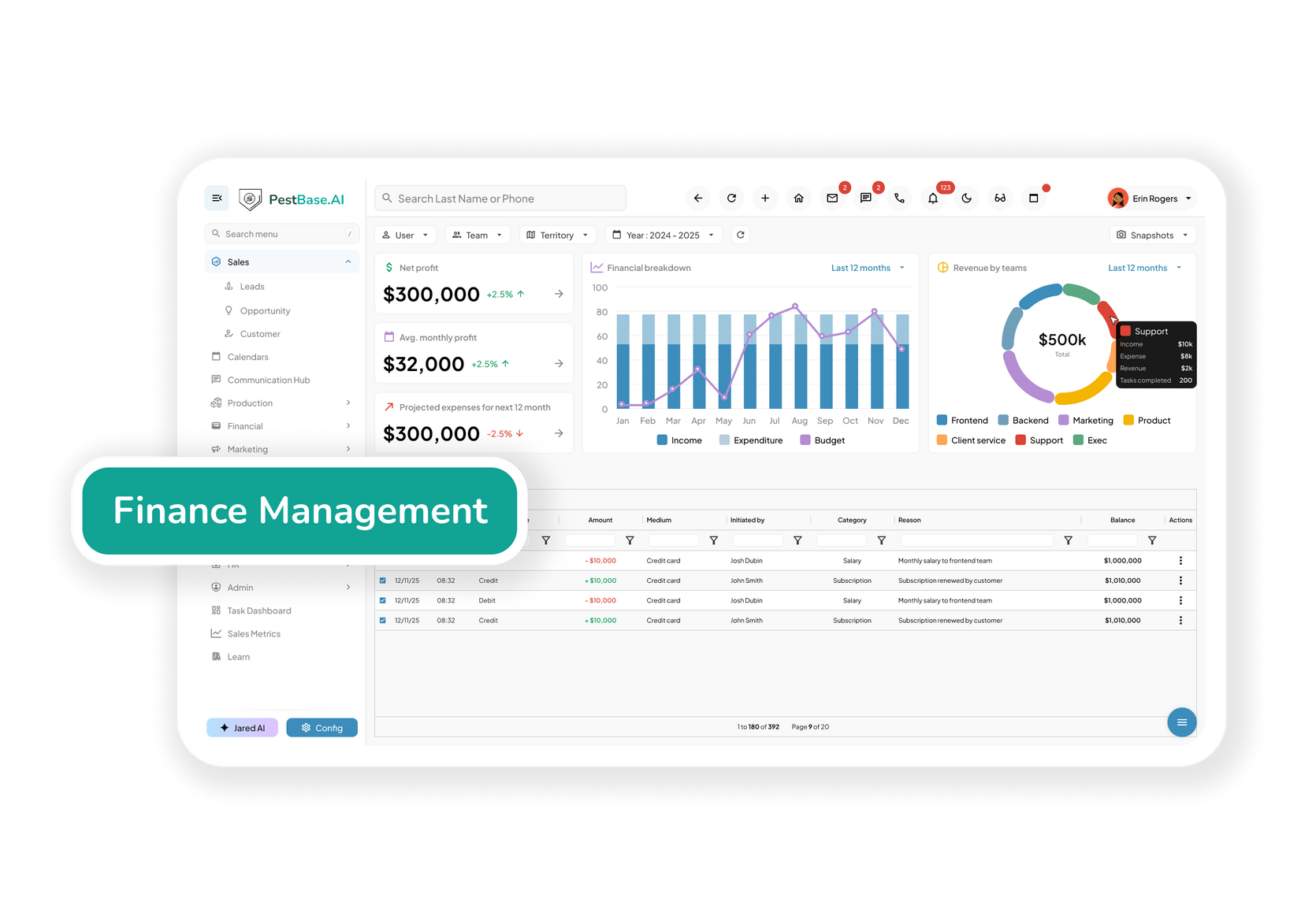
10:40 AM · Recurring charges run
Most of the money in pest control arrives on a schedule: quarterly plans, annual bonds, monthly commercial contracts. The billing for it shouldn't need a person.

Recurring plans should bill themselves
Most of the money in pest control arrives on a schedule — quarterly plans, annual bonds, monthly commercial contracts. The billing for it shouldn't need a person.
- Run recurring billing on each plan's own cycle, so a quarterly customer and a monthly commercial account both bill on time without a manual run.
- Keep a card or bank account on file and charge automatically, which is the single biggest reduction in collections work available to a recurring service business.
- Bill termite bond and warranty renewals against their anniversary dates, so a renewal isn't discovered after it lapsed.
- Recover failed payments automatically — an expired card retried and chased is revenue kept; an expired card ignored becomes an involuntary cancellation.
- Handle annual prepay alongside per-service billing, including the discount structures customers take those plans for.
12:15 PM · Payments start coming in
Most late payments aren't disputes. They're friction: an invoice that needed a cheque, or a portal login nobody could find.
Make paying the easy option
Most late payments aren't disputes. They're friction — an invoice that needed a cheque, or a portal login nobody could find.
- Share invoices through a customer portal where they can view, pay, and see their service history in one place.
- Accept credit cards, debit cards, ACH, and digital wallets directly from the invoice, so paying takes one tap rather than a phone call.
- Process payments through PCI-compliant handling to help protect customer payment information.
- Send automated reminders on outstanding balances, so following up doesn't depend on someone in the office having time.
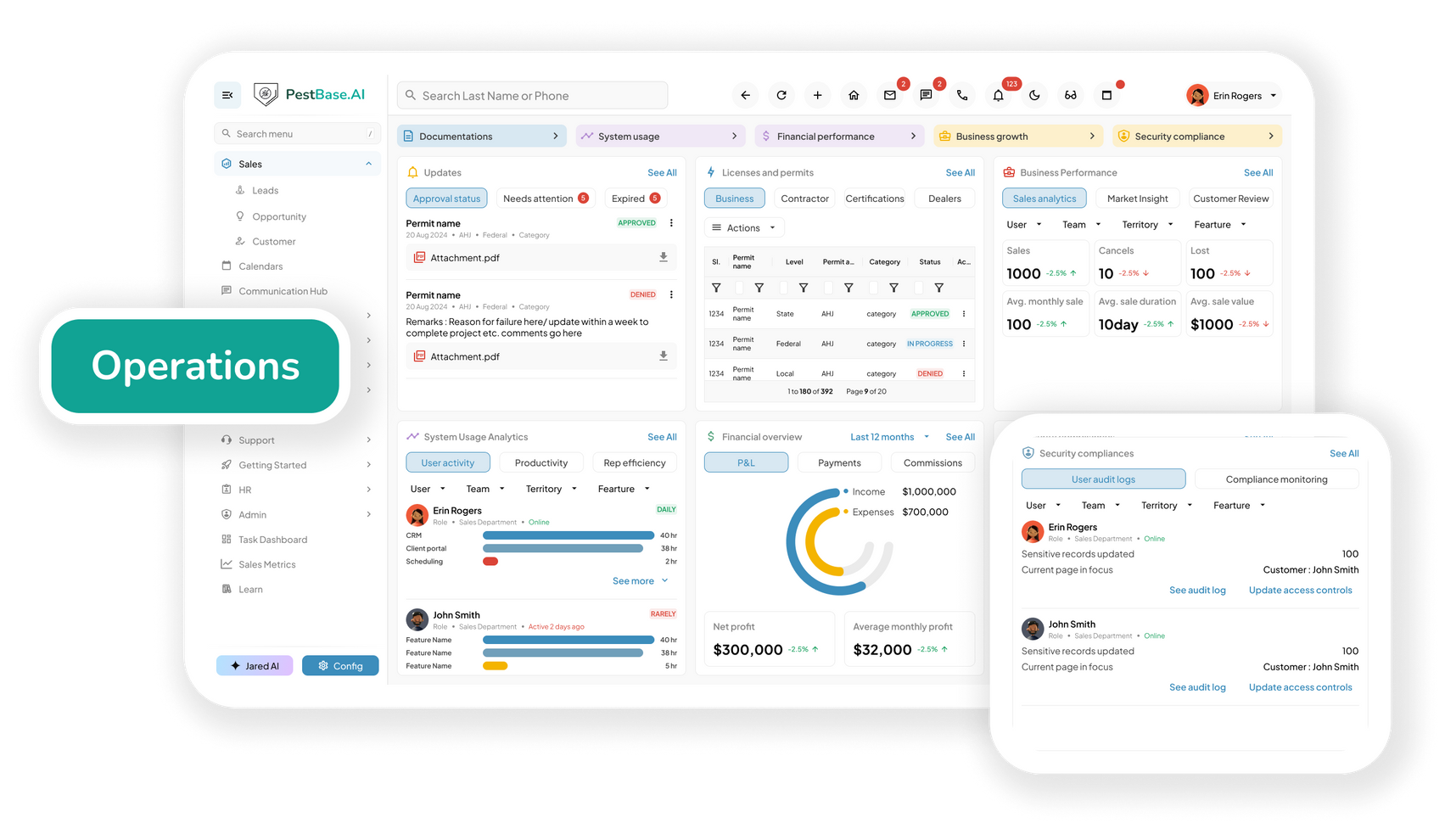
2:30 PM · Checking commercial receivables
A homeowner pays a card at the door. A restaurant group pays net 30 through an accounts payable department that will reject an invoice without a purchase order number on it.
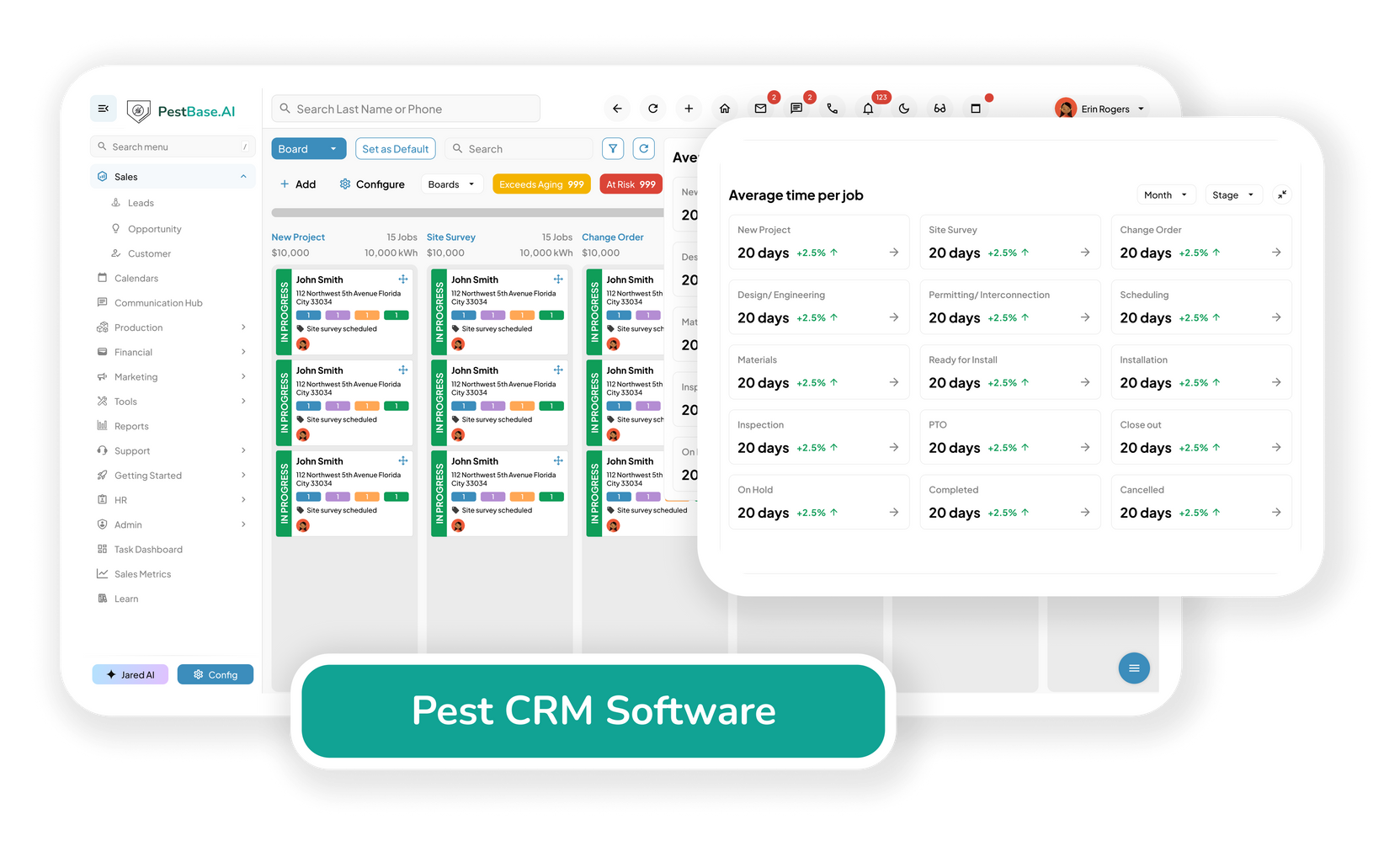
Commercial accounts pay differently
A homeowner pays a card at the door. A restaurant group pays net 30 through an accounts payable department that will reject an invoice without a purchase order number on it.
- Issue invoices on net terms with purchase order numbers and cost centers included, so they clear AP instead of coming back.
- Consolidate multi-site accounts onto one invoice, or split by location — whichever the customer's finance team requires.
- Track receivables aging by account, so a large commercial balance drifting past 60 days is visible before it becomes a collections problem.
- Attach service documentation to the invoice, which is often what an AP department needs before it will approve payment on a contracted service.
4:45 PM · Closing out the numbers
PestBase isn't your accounting system, and shouldn't try to be. It should hand your accounting system data that doesn't need fixing.
Clean numbers for whoever does your books
PestBase isn't your accounting system, and shouldn't try to be. It should hand your accounting system data that doesn't need fixing.
- Export general ledger data to QuickBooks, removing the manual entry where most small-company accounting errors originate.
- Calculate state and local taxes on estimates and invoices automatically, which matters as soon as you're servicing across jurisdictional lines.
- Track performance against the metrics that actually describe this business — recurring revenue, revenue per technician, average ticket, and attrition — not just an invoice total.
- Export reports as PDF or CSV to share with your bookkeeper, accountant, or lender without rebuilding them by hand.
Why Money Goes Misisng
Three places pest control revenue quietly leaks
The card that expired
A recurring customer's card is declined, nobody notices, and three months later they've been a free customer. They didn't cancel — the payment just stopped.
The invoice that never went
A service was completed and closed, but the invoice sat in a weekly batch that skipped it. Nobody finds it until a customer mentions they were never billed.
The bond that lapsed
A termite renewal came due, no invoice was raised, and the warranty ended without anyone deciding it should. The customer finds out when they need it.
Frequently asked questions
Can we charge recurring customers automatically?
Card or bank details can be kept on file and charged on each plan's billing cycle, so quarterly and monthly accounts bill without a manual run.
Does it integrate with QuickBooks?
Yes. General ledger data exports to QuickBooks, so invoices, payments, and revenue don't have to be re-keyed into your accounting system.
Can technicians take payment in the field?
Yes. The invoice generates from the completed service and payment can be taken on site by cash, card, or ACH, with status updating centrally straight away. See the technician app.
How are termite bond renewals billed?
Bond and warranty renewals are tracked against their anniversary date on the agreement record and billed on schedule. See termite management.
Can we invoice commercial accounts on net terms with a PO number?
Invoices can carry purchase order numbers and payment terms, and multi-site accounts can be consolidated or split by location depending on what the customer's finance team needs.
Is PestBase an accounting system?
No. It handles invoicing, payments, and revenue reporting for your service operation, then exports clean ledger data to QuickBooks. Your accountant keeps the tool they already know.
Close gaps. Keep revenue moving.
Bill sooner. Collect faster. Keep the renewals.
Bring a month of real invoicing and we'll show you where the gaps are and what closes them.
Or call 1-888-678-6227