
March 1, 2026
Running a pest control business today feels more difficult than it did a few years ago. The work itself has not changed much. Pests still need to be treated, customers still expect timely service, and teams still work on the ground every day. What has changed is the volume of work.
As businesses grow, daily operations become heavier. More customers mean more calls, more pest control jobs, more invoices, and more follow-ups. What once felt manageable with notebooks, spreadsheets, and phone calls slowly turns into daily stress.
You need pest control business software designed for pest control services, including job form generation, payment reminders, and real-time data tracking to help with smooth office operations.
How the Right Pest Control Software Supports Faster Daily Operations?
Technicians are expected to do more than just pest control. They manage routes, write service notes, take photos, collect signatures, and answer customer questions. When all this is done on paper or memory, mistakes are common.
Most pest control companies face the same struggles every day.
- Pest control operators juggle multiple locations, service notes, chemical usage, and critical data.
- Office teams handle calls, assign jobs, create invoices, and chase payment.s
- Owners try to track performance while solving daily fires
This blog explains how modern pest control software simplifies daily operations. It shows how automation, visibility, and structure reduce stress across scheduling, service, billing, and reporting. It also explains how PestBase supports pest control businesses at every stage of growth.
Key Takeaway
- Manual processes may work early on, but as a pest control business grows, they start causing delays, confusion, and extra effort across daily operations.
- Scheduling changes, missing service details, and delayed billing are usually the biggest pain points that slow teams down and impact customer experience.
- Pest control software provides structure and clarity by streamlining schedules, service data, and billing in a single, organized system.
- When tools are simple to use, technicians focus more on service, office teams work faster, and customers get timely, professional communication.
- With the right system in place, PestBase helps businesses scale smoothly.
Ready to bring clarity to your daily operations? See how PestBase helps pest control businesses run smoothly and grow with confidence.
What Does “Daily Operations” Actually Look Like in Pest Control?
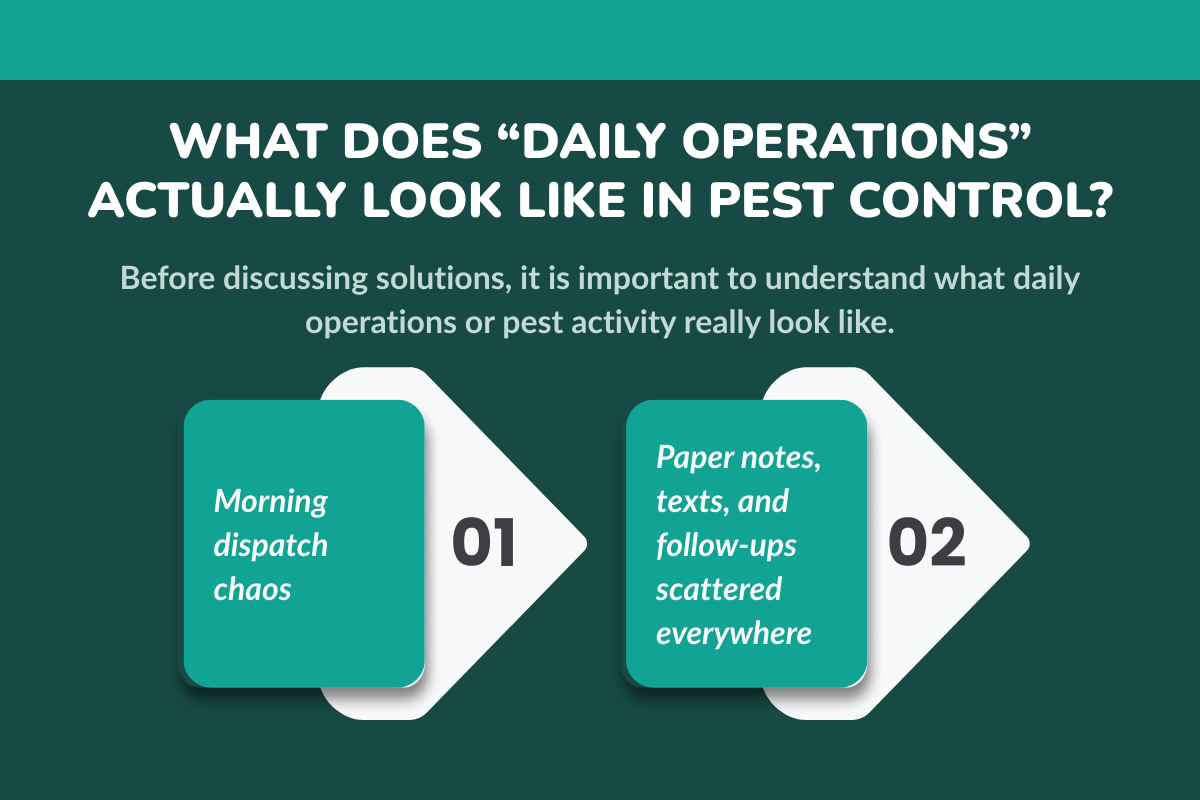
Before discussing solutions, it is important to understand what daily operations or pest activity really look like.
A. Morning dispatch chaos:
Most mornings start with scheduling process challenges.
- Pest Control technicians are calling about pest control route changes.
- Customers are rescheduling at the last minute.
- Emergency jobs needing immediate attention.
Without a central system, schedules are updated through calls, texts, and handwritten notes.
B. Paper notes, texts, and follow-ups scattered everywhere:
Service details live in many places. Some are on paper, some on WhatsApp, some in spreadsheets. There is no single source of truth.
C. End-of-day billing delays and missing details:
Invoices are often created at the end of the day or even later. Missing service details cause delays. Sometimes invoices are sent days after the job is done.
D. Why do these small inefficiencies stack up fast?
One missed note does not look serious, but when it happens daily, the impact grows.
- Delayed payments
- Missed follow-ups
- Lost service history
- Customer complaints
Over time, these small issues hurt the growth of the entire business.
Where Manual Work Slows Pest Control Businesses the Most?
When pest control teams rely on paper, calls, and memory, small issues turn into daily headaches. These are the areas where manual work hurts the most.
1. Scheduling and routing that change every day
Pest control schedules change all the time. Customers cancel, emergencies pop up, and routes need to be reshuffled.
When updates are shared through calls or texts, it is easy to miss something. One missing piece of paperwork can send a pest control technician to the wrong place or leave a potential customer waiting.
Office staff spend hours fixing schedules instead of planning ahead. Jobs are moved on paper, spreadsheets, or whiteboards, which quickly become outdated. This leads to wasted drive time, overtime costs, and low customer satisfaction.
2. Service documentation that lives in too many places
Every pest control inspection visit includes important details like treatments used, pest activity, photos, and customer information. When this is written on paper or remembered later, things get lost. Notes get misplaced, photos stay on Android devices, and service history becomes incomplete.
When customers ask questions later, teams struggle to find answers. Missing or unclear records also slow down billing and reduce customer trust.
3. Billing and follow-ups that happen “when there’s time.”
Manual billing usually happens later, not right after the job. Paper tickets pile up, invoices go out late, and payments take longer to come in. Small field service businesses are sometimes forgotten, which means lost revenue.
Follow-ups suffer too. Sending appointment reminders and repeat visits are easy to miss when there are no pest control software tools prompting the team. Missed follow-ups mean missed cash flow.
Watch how pest control software improves route efficiency: How Pest Control Software Improves Route Efficiency & Boosts Technician Utilization.
What is Pest Control Software, and who needs it?
Pest control software is a single system built to run a pest control company. It helps manage everything from booking jobs to sending technicians out and getting paid. Unlike general service tools, it is made specifically for how pest control businesses work.
Pest-specific software supports tasks such as treatments, inventory management, job management, inspections, signed contracts, and sales tools, delivering unparalleled customer experiences. For example, PestBase is built to handle termite checks, rodent jobs, and ongoing pest plans through the right software.
Who needs it?
- Owners and Managers: They can see how the business is performing in real time and make better decisions using clear data.
- Dispatchers and Office Teams: It will help them manage schedules, pest control route changes, and customer updates without chasing technicians.
- Field Technicians: They will know where to go, what to do, and can finish paperwork on site without paper forms.
- Billing and Finance Teams: By using the software, they can send invoices, track and accept online payments, and manage commercial accounts without delays or manual follow-ups.
What are the Core Features That Define High-Performance Pest Control Software?
Let's have a look at the feature list that makes pest software more compelling in the pest control industry:
Feature 1: Smart Job Scheduling and Route Optimization
Scheduling should take minutes, not hours. With this feature, the jobs can be moved easily with drag-and-drop. Routes are planned automatically to reduce costs.
Also, managers can see job progress in real time with GPS tracking. Customers get automatic reminders, so fewer no-shows happen, and emergency jobs or cancellations can be adjusted quickly. This pest control scheduling software removes constant phone calls, confusion, and wasted driving.
Feature 2: Mobile App for Field Technicians
Technicians should not deal with paperwork. This means all job details should be available on the phone, and service notes and inspections are filled digitally.
Through this feature, the photos can be uploaded directly from the site, and customers can sign in to the customer portal on the device, and everything syncs instantly with the office. Techs enter details once in this pest control service software and move on to the next job.
Feature 3: Automated Invoicing and Payments
Getting paid should be fast and simple. Therefore, by using this feature, invoices are created as soon as a job is completed. Bills are sent instantly by email or text.
Moreover, customers can pay online or by card with convenient payment options, recurring services are also billed automatically, and unpaid invoices are tracked without manual follow-ups. This pest control management software feature improves cash flow and helps get paid faster.
Feature 4: Reporting and Performance Analytics
Good decisions need clear data. Track revenue per technician. See job completion and cancellation rates.
Understand which services make the most profit. Monitor customer renewals and retention. Spot problems early before they impact revenue. Instead of guessing, owners can act with confidence.
A Day in the Life With Best Pest Control Software
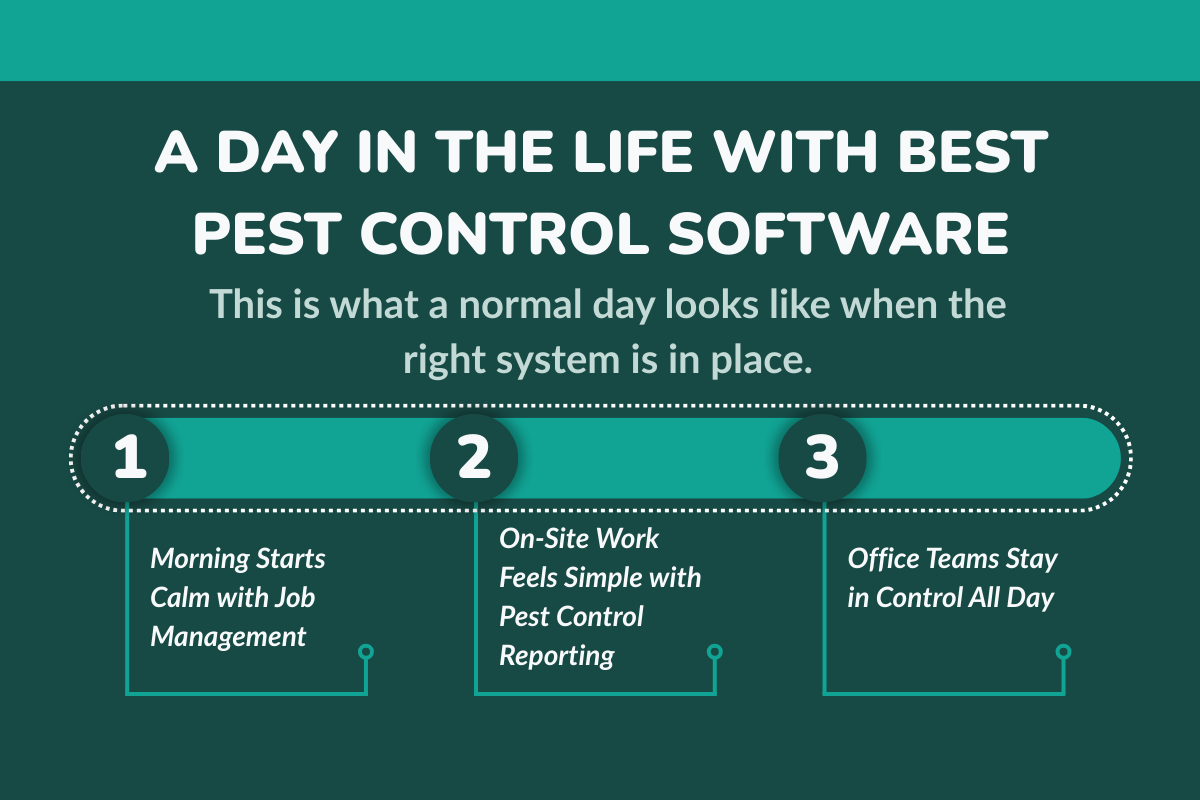
This is what a normal day looks like when the right system is in place:
I. Morning Starts Calm with Job Management
The day begins with the office opening the pest control routing software and seeing all jobs laid out clearly. Routes are already organized based on location and technician availability. Technicians check their phones and instantly know where to go and what their day looks like.
II. On-Site Work Feels Simple with Pest Control Reporting
When a technician reaches the first job, everything they need is already on their screen. Customer notes, past service details, and instructions are easy to see on field service management software.
The inspection is logged on the phone, photos are taken if needed, and the customer signs right there. No paperwork to carry, no details to remember later.
III. Office Teams Stay in Control All Day
Back in the office, the team can see job progress live. Completed jobs are marked automatically. If a customer needs to reschedule, the change is made in seconds, and the technician sees it instantly. No chasing. No back-and-forth calls.
IV. Billing Happens Without Delay
As soon as a job is completed, the invoice is created and sent. Contract customers are billed automatically and receive a payment link; many pay on the same day via an online portal. This way, the finance team receives payments without follow-ups or reminders.
V. End the Day With Clarity
At the end of the day, the owner checks the dashboard and sees exactly how the business performed. Jobs completed, revenue earned, new customers added in just a few clicks, and nothing is missing.
Here is the guide and list of the best pest control tools that help your pest business: Best Digital Tools for Pest Management Teams in 2026
Why Operations Simplicity Directly Impacts Revenue?
| Area of Operations | What Improves in Daily Work | How It Impacts Revenue |
|---|---|---|
| Faster Job Completion | Better scheduling and routing reduce travel time and gaps between jobs. | Technician productivity can improve by 10–15%, allowing more jobs to be completed without adding staff. |
| Higher Customer Retention | Consistent service, reminders, and accurate billing build trust. | A 5% increase in customer retention can lead to significant profit growth over time. |
| Improved Employee Productivity | Less manual work reduces confusion, overtime, and burnout. | Teams spend 15–20% more time on billable or productive work instead of fixing errors. |
When Pest Control Software Becomes a Growth Enabler?
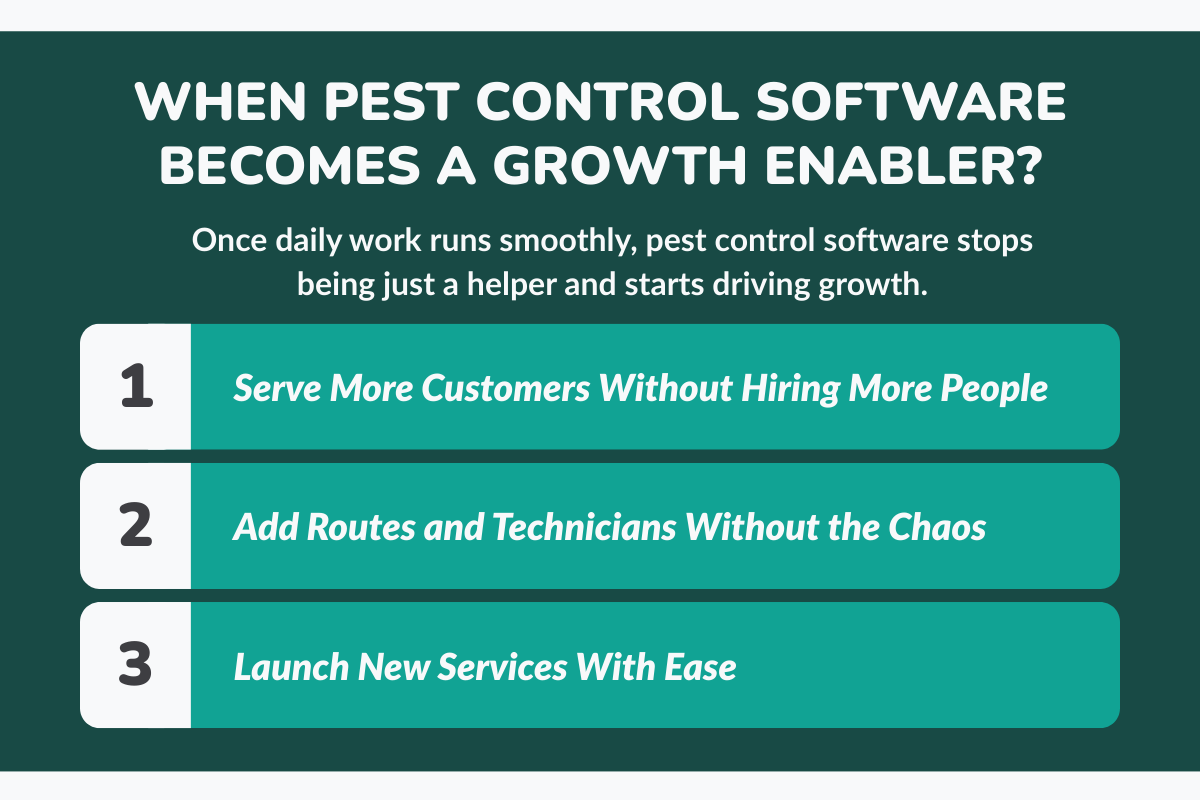
Once daily work runs smoothly, pest control software stops being just a helper and starts driving growth.
A. Serve More Customers Without Hiring More People
When scheduling, service notes, customer communications notes, and billing are automated, your team can handle more work without feeling stretched. Office staff spend less time coordinating and more time supporting growth. The system scales your capacity, not your workload.
B. Add Routes and Technicians Without the Chaos
As you grow, adding new technicians or service areas becomes simple. New routes, zones, and team members plug straight into the system. There is no need to rebuild schedules or manage multiple spreadsheets.
C. Launch New Services With Ease
Want to add new pest services or expand offerings? With business management software already in place, you just add the pest service. Scheduling, billing, and reporting work the same way, so nothing breaks.
Common Mistakes When Implementing Pest Control Software
Even good pest control business software can fail if it is set up or used incorrectly. Therefore, these are some common mistakes pest control businesses should avoid:
Mistake 1. Choosing the Wrong Type of Software
Many businesses pick generic field service tools that are not built for pest control. These systems often miss important features like inspections, contracts, or recurring services. The result is workarounds, extra spreadsheets, and frustration. Pest control software should fit your workflow, not force you to change how you work.
Mistake 2. Not Getting the Team Onboard
Pest Control Software only works if people actually use it. Skipping proper training or ignoring technician feedback leads to low adoption. When techs feel the system is hard to use, they fall back on old habits. Involving the team early and providing hands-on support makes a huge difference.
Mistake 3. Growing Without Clean, Connected Data
Using pest software for some tasks while still relying on paper or separate tools creates confusion: data gets split, reports become unreliable, and teams lose visibility. Growth works best when everything lives in one system, and everyone follows the same process.
How PestBase Simplifies Pest Control Operations at Scale?
PestBase is built to make running a pest control business feel simpler, even as it grows. It brings scheduling, service tracking, billing, and reporting into one place, so teams stop jumping between tools and start working from a single system.
What makes PestBase scale so well is that it grows with your business.
- It works just as smoothly for a small team managing a few routes as it does for larger operations handling multiple technicians, locations, and service types.
- Everything stays connected, organized, and easy to manage.
- Instead of adding more manual work as you grow, PestBase helps you handle more jobs, more customers, and more teams without adding chaos.
- It helps you run daily pest operations smoothly.
Conclusion:
Growing a pest control business is hard when daily work still depends on paper, calls, and manual follow-ups. Those small tasks slow everything down and make growth feel stressful. When operations are simple and structured, the business runs more smoothly.
This is where PestBase makes the difference. It helps pest control businesses replace daily chaos with control by consolidating scheduling, service, billing, and reporting into a single system.
Simplify Operations With PestBase
Instead of adding pressure as you grow, PestBase gives you the structure to handle more customers, more technicians, and more jobs with confidence. If you want to scale your pest control business without burning out your team, schedule a demo now.
FAQs
1. Which is the most widely used pest control software?
PestPac, FieldRoutes, and PestBase are examples of well-known pest control software programs. The type of pest control software most commonly used by businesses often depends on the company's size and its needs for that type of pest control.
2. What is the highest salary for a pest control technician?
The highest-paid pest control technicians will typically have years of experience and hold specialist or supervisory roles. Typically, pest control technicians can earn anywhere from $60,000 to $80,000, especially for areas such as termite or commercial pest control.
3. What are common pest control mistakes?
One common mistake is skipping proper inspection before treatment. Many businesses also fail to document service details clearly or follow up with customers on time. Using the wrong chemicals or inconsistent scheduling can also lead to repeat infestations and unhappy customers.
4. What is the most common pest control problem?
Ants and cockroaches are the most common pests in homes and businesses. They spread quickly, return often, and are hard to eliminate without consistent treatment. Poor sanitation and easy access to food make these pests especially common.