
February 19, 2026
If you run or manage a pest control business today, chances are you don’t feel under-equipped. You feel over-equipped.
There’s a sprayer for one job, a duster for another, three types of traps in the truck, different safety gear depending on the chemical, and still, callbacks happen. Reports pile up. New technicians take longer to get confident. Margins feel tighter even when work is steady.
That’s the reality of pest control in 2026. Customer expectations are higher. Regulations are stricter. And the industry has quietly shifted from “just treat the problem” to general pest management focused on prevention, monitoring, and documentation.
Best Tools for Pest Management in 2026: A Practical Guide for Modern Pest Control Teams
Pest management in 2026 is about using the right pest control tools and equipment together, not just applying chemicals when pests appear. Modern pest control focuses on accurate inspections, targeted treatments, safety, and ongoing monitoring to prevent recurring issues.
This approach supports integrated pest management by helping technicians control pests more effectively while reducing unnecessary pesticide use. As pest control operations grow, tool overload, safety compliance, and inconsistent results become common challenges. Choosing the right pest control equipment helps teams work faster, stay compliant, and deliver consistent service across jobs.
A well-organized tool stack also improves technician confidence, customer trust, and day-to-day efficiency for pest control companies.
This guide is for pest control business managers, team leads, and service companies. It explains how to choose and organize the best tools for pest management in 2026.
Key Takeaways
- Having more pest control tools doesn’t automatically improve results. In many cases, it adds confusion, slows technicians down, and increases training time.
- Effective pest management today goes beyond chemicals. It relies on accurate inspections, consistent monitoring, and clear documentation across every job.
- Tool overload has become a real operational risk in 2026, leading to missed details, repeat visits, and unnecessary costs.
- The strongest pest management setups focus on precision, safety, and well-connected systems that support technicians instead of overwhelming them.
If tool overload is slowing your pest control operations, the solution isn’t more equipment; it’s better organization. See how PestBase helps teams manage inspections, treatments, and records in one clear system, without adding complexity.
What Does Pest Management Really Mean Today?
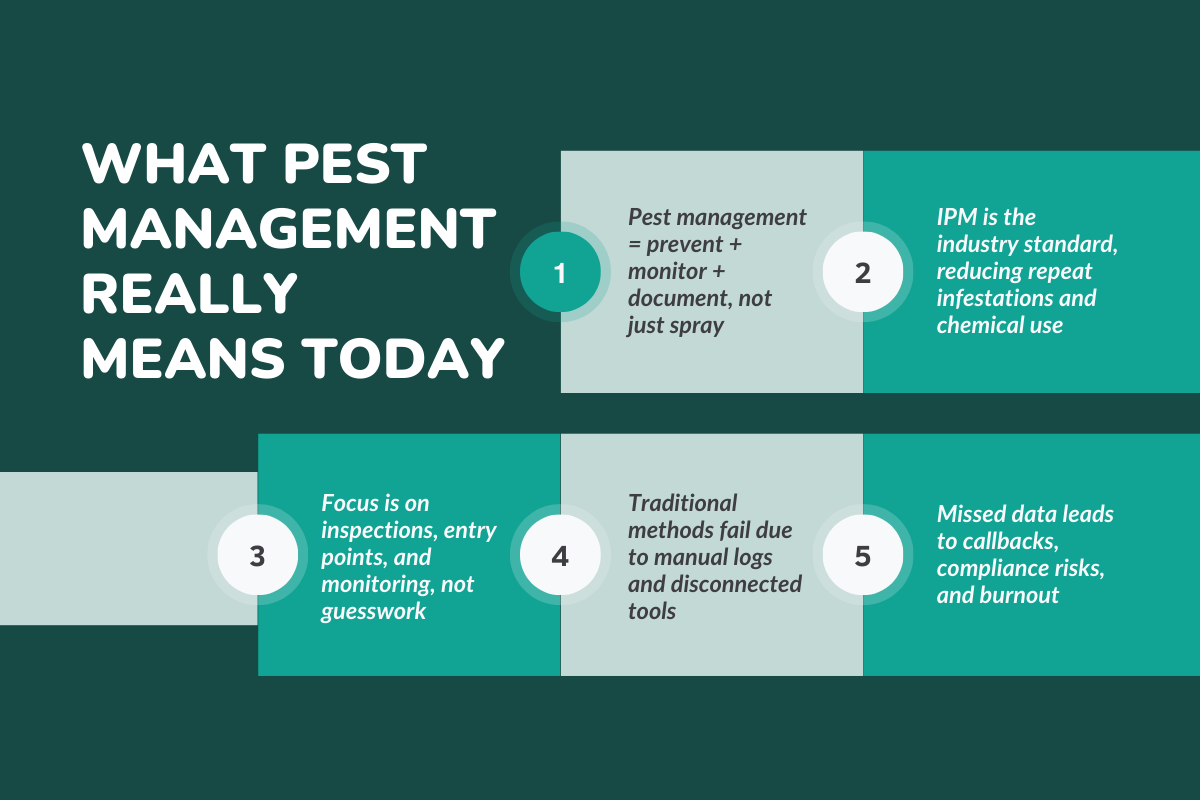
Pest management today goes beyond reacting to visible pests. It’s about understanding why pests appear, how they spread, and what it takes to prevent them from returning.
1. From Reactive Pest Control to Integrated Pest Management (IPM)
Pest control used to be straightforward: identify the pest, apply pesticides, move on to the next job. That model doesn’t hold up anymore.
Integrated pest management (IPM) has become the industry standard across residential, commercial, and institutional settings. IPM focuses on:
- Accurate inspections
- Identifying entry points like cracks, wall voids, crawl spaces, and tight corners
- Monitoring pest activity over time
- Using chemicals only when necessary, and applying them precisely
Industry studies consistently show that IPM programs reduce repeat infestations and chemical usage while improving customer satisfaction. In simple terms: less reaction, more prevention.
That shift changes the role of tools. Equipment now needs to support inspections, monitoring, and record-keeping, not just liquid applications.
2. What Are the Limitations of Traditional Pest Control Methods?
Many pest control operations still rely on manual logs, paper customer records, disconnected tools and equipment, and technician memory instead of systems.
The result?
- Missed bed bug evidence during inspections
- Inconsistent mosquito control and ant control results
- Lost compliance documentation
- Technician burnout and unavoidable callbacks
Traditional methods don’t fail because technicians lack skill. They fail because the systems around them haven’t evolved.
Too many tools, too little time? PestBase brings your inspections, treatments, and reports together in one clean system. Check it out and make your day easier
Why Tool Overload Is The Biggest Pain Point in 2026?
Tool overload doesn’t happen overnight; it builds slowly. A new problem shows up, bed bugs, carpenter ants, termites, and a new tool gets added. A different technician prefers a different sprayer. Entry-level models get replaced but never removed from inventory.
Over time, trucks carry: More tools, More chemicals, More confusion. But not more consistency.
How Tool Overload Hurts Productivity and Profitability
Too many tools create hidden costs:
- Slower inspections because technicians switch equipment constantly
- Training gaps for new hires
- Safety risks when protective gear isn’t standardized
- Poor inventory tracking
One real-world scenario looks like this: One job. Five tools were used, no clear record of what worked, and no insight into what failed.
What is the Must-Have Pest Control Equipment for Field Teams?
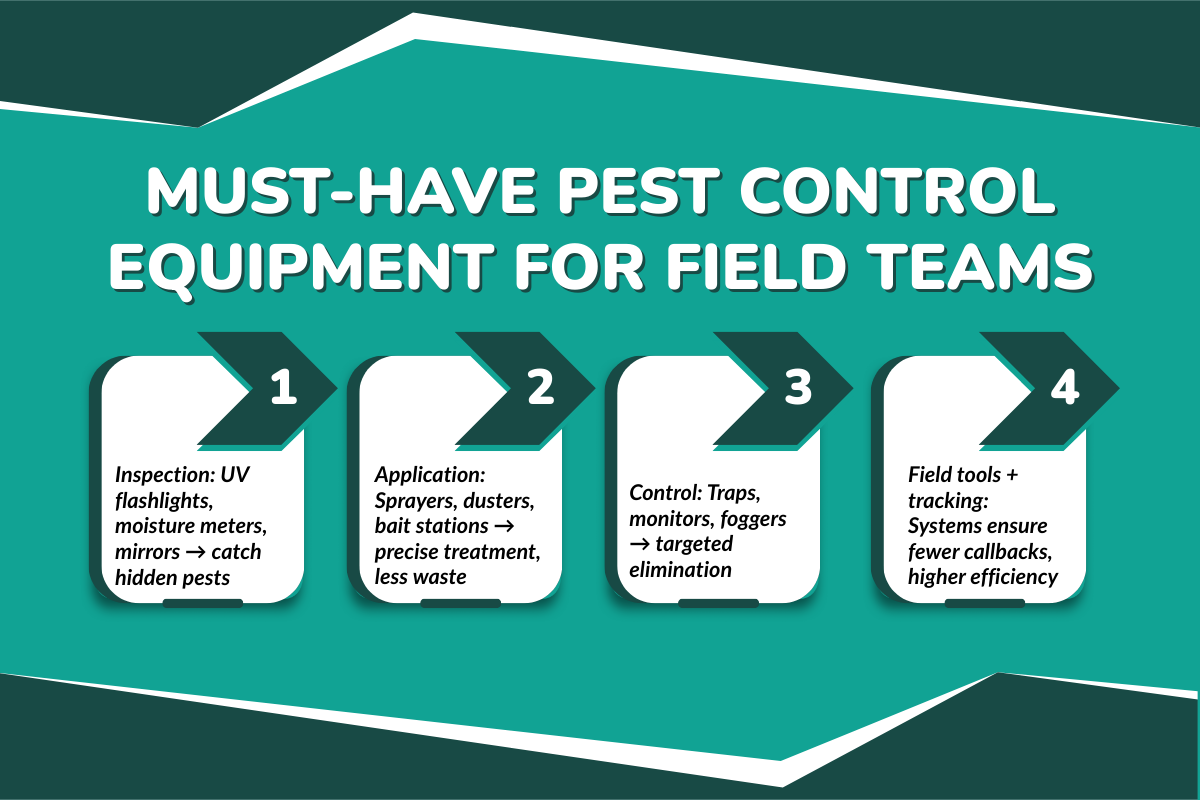
1. Inspection Tools That Actually Save Time
Good pest management starts with seeing what the naked eye usually misses. Essential inspection tools include:
- UV flashlight for spotting bed bug traces and rodent activity
- Moisture meters to detect conditions attracting termites and cockroaches
- Telescoping mirror for inspecting wall voids, behind appliances, and crawl spaces
Accurate inspections reduce unnecessary pesticide use and improve long-term success.
2. Application Tools for Precise Pest Control
Precision matters more than volume in 2026. The most effective application equipment includes:
- Stainless steel sprayers for durability and consistent liquid applications
- Backpack sprayers for larger properties
- Bulb duster for tight cracks and voids
- Bait stations for targeted control of crawling insects
Studies consistently show that precision indoor applications reduce re-treatment frequency and chemical waste.
3. Control Equipment for Common Infestations
Different pests require different control equipment:
- Snap traps and glue boards for rodents
- Bait stations for ants and cockroaches
- Monitoring systems for termites
- Thermal foggers for specific flying insect scenarios
Knowing when to replace equipment and when to maintain it keeps operations efficient. But here is the take: field tools solve only part of the problem. Without proper tracking, reporting, and follow-ups, even the best equipment can lead to repeat visits and missed details.
That’s why many pest control teams now rely on digital tools alongside field equipment to support inspections and daily operations.
What Safety Equipment Does Every Pest Control Team Need to Have?
1. Personal Protective Equipment (PPE) in 2026
Safety equipment is no longer optional or minimal. Must-have protective gear includes:
- Safety glasses
- Chemical-resistant gloves
- Respirators when handling pesticides
- Protective coveralls
Protective gear protects technicians, but it also protects the business from compliance issues and lost contracts.
2. Compliance, Documentation, and Customer Trust
Customers increasingly ask questions about safety, and auditors expect clear documentation. Companies with standardized safety equipment and records:
- Pass inspections more easily
- Win commercial contracts faster
- Experience fewer incidents and claims
Safety is now part of brand trust.
Replacement Parts: The Most Overlooked Cost in Pest Management
Most pest control teams focus on buying the right tools but overlook what keeps those tools working. Replacement parts rarely get attention until something breaks, and by then, the cost is already showing.
A broken sprayer doesn’t just delay a job. It affects technician schedules, customer confidence, and emergency spending on replacement parts.
Downtime quietly eats margins. Understanding this hidden expense is key to keeping pest control operations efficient and predictable. Smart teams manage replacement parts. They apply efficient pest control operations to:
- Standardize equipment models
- Stock essential replacement parts
- Track tool maintenance alongside jobs
This consistency reduces chaos. High-quality pest control ensures treatments are applied correctly and consistently, leading to better results and less waste.
DIY Pest Control Tools vs Professional Pest Control Tools
Many customers try DIY pest control because it feels quick, simple, and cheap. But there’s a clear line between what DIY tools can handle and what requires professional expertise. Professional pest control technicians have access to advanced tools and products that are not always available to homeowners, allowing them to treat hard-to-reach pest hideouts and perform treatments more safely and efficiently.
DIY tools can handle:
- Small, contained infestations
- Occasional invaders (like ants or spiders)
- Preventative measures (sealing cracks, setting traps)
Homeowners can use snap traps, diatomaceous earth, and caulk to implement DIY pest management effectively.
1. What DIY Pest Control Tools Can and Can’t Do
DIY tools can work for minor issues like ant trails and early-stage crawling insect activity.
They often fail when:
- Pests are hiding in wall voids, crawl spaces, or tight corners
- Infestations involve bed bugs or termites
- Ongoing monitoring and prevention are needed
2. How Pest Control Companies Can Position Against DIY
The best approach isn’t to compete on price, it’s to educate:
- Explain the benefits of long-term prevention
- Highlight why professional inspections uncover hidden problems
- Show that tools are part of a systematic, safe approach, not just gadgets
This helps customers see the difference without feeling intimidated and also results in customer Retention.
Pest Control Software: The Backbone of Modern Pest Management
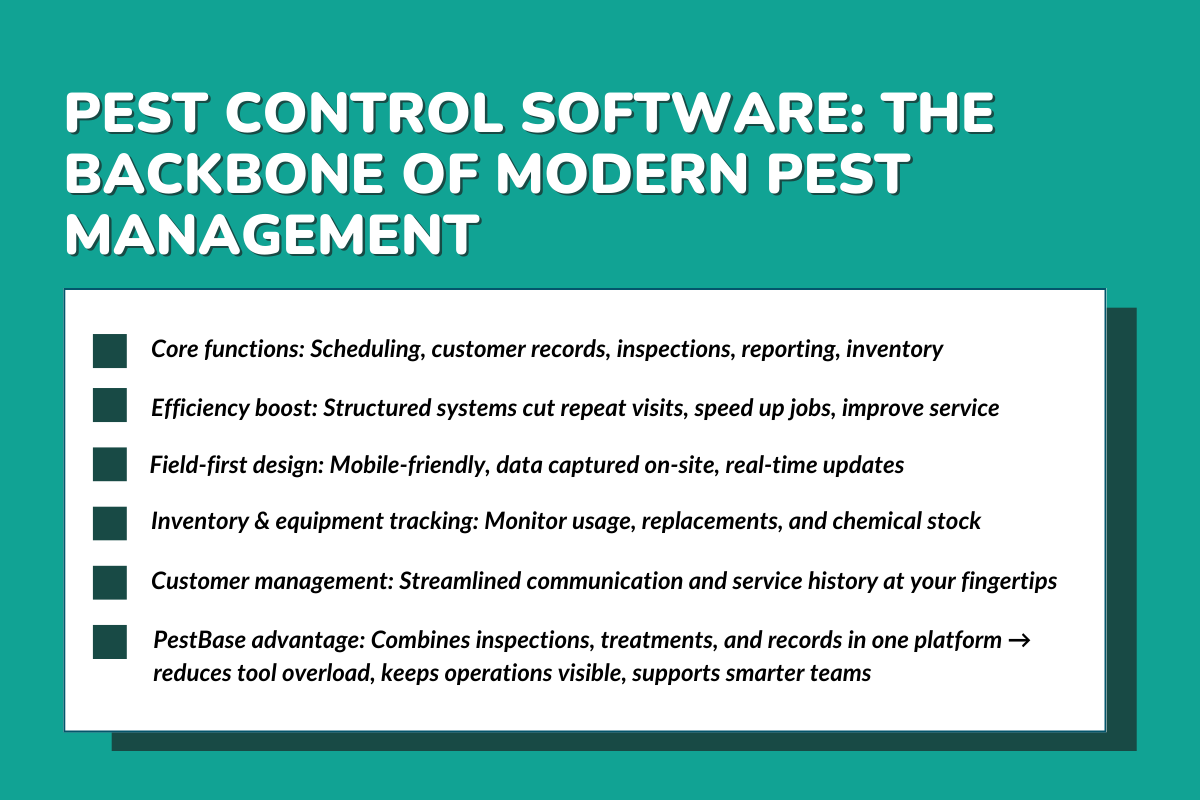
As pest control operations grow, relying on memory and manual records stops working. Software has become essential for keeping teams efficient, organized, and consistent.
1. Why Software Is Now a Core Pest Management Tool
Modern software supports:
- Scheduling and job management
- Customer records and service history
- Inspections, reporting, and compliance tracking
- Inventory and chemical management
Industry data shows that companies using structured systems complete jobs faster, reduce repeat visits, and improve overall service quality.
2. What to Look for in Pest Control Software in 2026
The right software should:
- Be mobile-friendly for technicians in the field
- Clearly store inspection and treatment data
- Track inventory, equipment usage, and replacement parts
- Facilitate smooth customer communication
Best Tools for Pest Management in 2026 (By Category)
Modern pest management works best when tools are chosen intentionally. Top-performing pest control companies build balanced stacks combining hardware, software, and monitoring, reducing admin time by 40–60% and re-treatment rates by 25–35%.
1. Hardware: Sprayers, Foggers & Applicators
Professional-grade equipment ensures precise, safe, and efficient treatments for various pest scenarios.
| Tool | Best For | Key Technical Capabilities | Operational Impact |
|---|---|---|---|
| B&G VersaFoamer 4000 | Large-scale termite & wall-void treatments | • Adjustable foam density for precision control • Consistent expansion ratio reduces over-application • Durable pump system for high-frequency use | • Up to 2× faster application • ~30% less chemical waste • Fewer callbacks from uneven treatment |
| Invatech ULV Fogger | Indoor & outdoor mosquito and flying insect control | • Ultra-low volume droplet sizing • Deep penetration into foliage and enclosed spaces • High-output motor for large-area coverage | • 70% better droplet penetration • Faster coverage with fewer passes • Improved treatment consistency |
| Atrix HEPA Vacuum | Bed bug removal & particulate cleanup | • True HEPA filtration (99.97%) • Sealed airflow system prevents cross-contamination • Compact design for residential jobs | • 95% HEPA filtration for safe cleanup • Safer cleanup for techs and occupants • Reduces reliance on repeat chemical treatments • Improves post-treatment inspection results |
2. Software: Routing, CRM & Scheduling
Centralized platforms streamline dispatching, customer management, and compliance.
| Tool | Core Strengths | Technical Capabilities | Measured Efficiency Gains | Pricing |
|---|---|---|---|---|
| PestBase | Operations-first pest control platform | • AI-based route optimization • Compliance-ready documentation • Mobile-first technician workflows • Centralized job, customer, and billing data | • 50% faster dispatching • Fewer missed jobs • Stronger technician accountability | Tiered or custom pricing based on features and usage. |
| PestPac | Enterprise-grade CRM & compliance | • Advanced route planning • Detailed chemical usage tracking • Audit-ready reporting • Scalable multi-branch support | • 30% reduction in admin time • Strong compliance control • Better reporting accuracy | Quote-based, with modular pricing depending on selected features. |
| FieldRoutes | Scheduling & reporting-focused platform | • Dynamic scheduling logic • Integrated reporting dashboards • Third-party accounting integrations | • 25% fewer callbacks • Improved schedule reliability • Better operational oversight | Quote-based or tiered pricing depending on business size and feature requirements (starts ~$199-$249/mo) |
| Jobber | Lightweight CRM for small teams | • Automated invoicing and reminders • Client self-service portal • Simple job scheduling | • 40% time savings for small teams • Faster payments • Reduced manual follow-ups | Core: $29/month Connect: $89/month Grow: $149/month |
3. Monitoring & Traps: Proactive Detection
Smart traps and IoT enable data-driven prevention.
| Tool | Key Feature | Technical Advantage | Re-Treatment Impact |
|---|---|---|---|
| ClimbUp Interceptors | Passive bed bug monitoring | • Non-toxic, no-power detection • Early-stage infestation visibility • Easy inspection during routine visits | • 40% fewer callbacks • Earlier intervention • Reduced chemical reliance |
| Tomcat Secure Stations | Rodent bait management | • Tamper-resistant design • Controlled bait exposure • Suitable for commercial & residential use | • 35% improvement in early detection • Safer bait handling • Better compliance outcomes |
| PestBoss Device Tracking | Digital monitoring & analytics | • Real-time pest activity dashboards • Historical trend tracking • Multi-site visibility | • 25% lower re-treatment rates • Data-backed treatment planning • Predictable service cycles |
4. Why This Stack Wins
- Integrated software like PestBase reduces route inefficiencies, while hardware ensures precise application.
- Proven ROI: Teams report approximately 20–30% revenue growth from faster service and fewer re-visits.
How to Build a Clean, Efficient Pest Management Tool Stack?
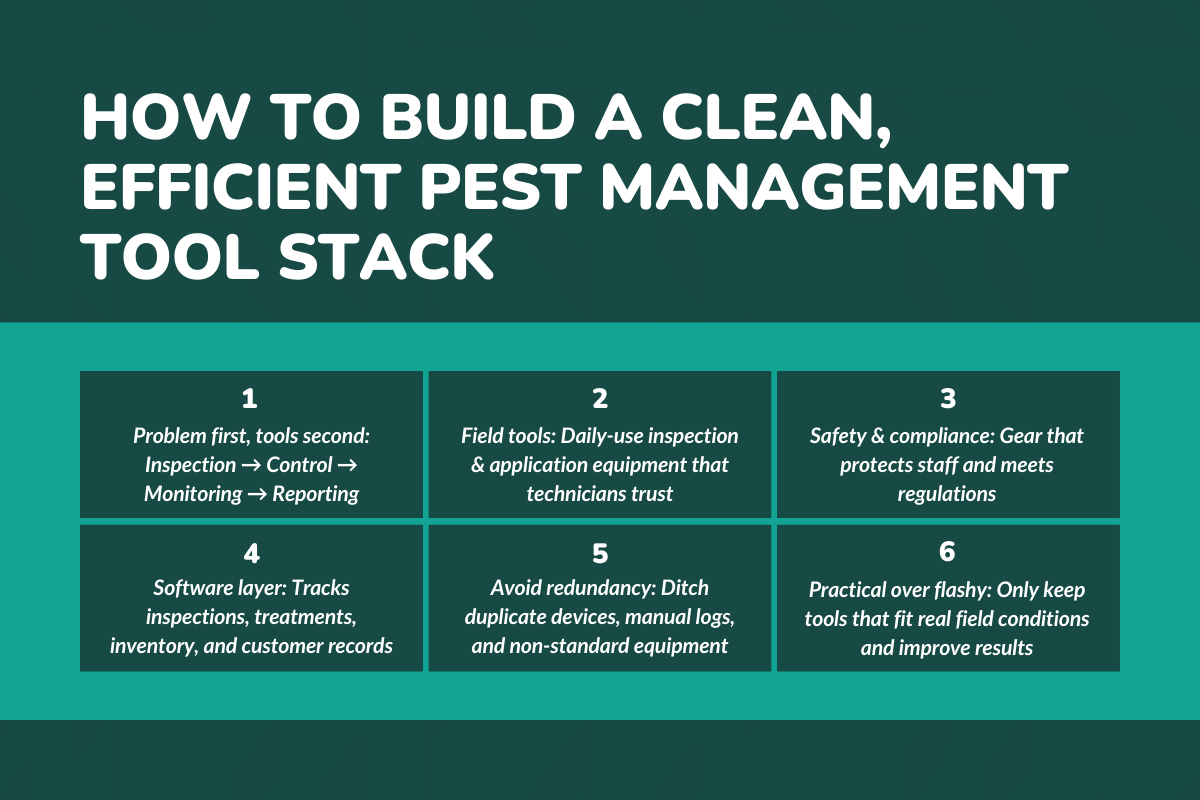
A strong pest management setup isn’t about owning more tools. It’s about knowing why each tool exists and where it fits in daily operations. When tools match real workflows, teams move faster, and mistakes drop.
1. Start With the Problem, Not the Tool
Most successful pest control operations follow the same simple flow:
Inspection → Control → Monitoring → Reporting
Each stage solves a different problem. Inspection tools help identify pests and risk areas. Control equipment handles the immediate issue. Monitoring tools confirm results over time. Reporting keeps teams aligned and customers informed. When tools support this flow, work stays organized and predictable.
2. A Simple 3-Layer Tool Stack Model
A clean tool stack usually includes three clear layers:
- Field tools for inspections and applications that technicians rely on daily
- Safety and compliance equipment that protects technicians and supports regulations
- Software systems that track inspections, treatments, inventory, and customer records
When these layers work together, pest control operations become easier to manage and scale.
What Pest Control Companies Should Stop Buying in 2026?
Not every tool improves results. Some quietly slow teams down and add confusion without delivering real value.
1. Redundant Tools That Don’t Improve Outcomes
Duplicate inspection devices, manual paperwork systems, and non-standardized equipment brands often create inconsistency. They increase training time, complicate inventory, and make it harder to deliver the same quality of service across jobs.
2. Tools That Look Advanced but Add No Value
Over-engineered gadgets, tools without proper training or support, and equipment that doesn’t fit real field conditions often end up unused. In 2026, practical and reliable tools matter more than flashy features.
Common Pest Control Mistakes to Avoid in 2026
Even experienced technicians can make mistakes that reduce service quality and customer trust. Common errors include using the wrong equipment, like liquid applications where foam or dust is needed, or relying on entry-level tools that break in tight corners or crawl spaces.
Neglecting safety gear, such as chemical-resistant gloves, safety glasses, and protective clothing, puts technicians at risk and can affect compliance. Skipping thorough inspections of wall voids, crawl spaces, and hidden areas also allows pests to go undetected.
Focusing on the right tools, safety equipment, and regular monitoring ensures jobs are done efficiently, safely, and consistently, delivering effective results every time.
What’s Next for Pest Management Tools Beyond 2026?
The future of pest management is becoming quieter and smarter, not louder and more complex.
1. Smarter Monitoring and Predictive Pest Management
Monitoring tools and data-driven inspections are helping teams spot patterns earlier, especially for termites, bed bugs, and recurring infestations. This shift allows pest control companies to prevent problems instead of repeatedly reacting to them.
2. Why Integration Will Matter More Than Innovation
The industry is moving toward fewer tools that work well together. Integrated systems reduce friction, improve visibility, and make daily operations smoother. Success will come from coordination, not constant tool upgrades.
Conclusion: Fewer Tools, Better Pest Management
Effective pest control in 2026 isn’t about having every tool available. It’s about choosing essential tools, maintaining them properly, and supporting them with systems that keep work clear and consistent.
When tools, safety equipment, and software work together, pest management becomes easier for technicians, more predictable for managers, and more trustworthy for customers.
About PestBase
Managing multiple tools, inspections, and records can overwhelm even the best teams. PestBase brings all your inspections, treatments, and customer data into one simple system, reducing confusion and saving hours of manual work. With real-time tracking, inventory visibility, and organized workflows, teams can focus on effective pest control, not paperwork.
Book a demo and streamline your operations and see results faster. Start optimizing your tool stack today.
FAQs
1. What are the best tools for pest management in 2026?
The best tools for pest management in 2026 include inspection tools like UV flashlights and moisture meters, precision application equipment such as stainless steel sprayers and bait stations, and proper safety equipment. Successful pest control companies focus on tools that support inspections, targeted treatments, and monitoring rather than relying only on chemical applications.
2. How is integrated pest management different from traditional pest control?
Integrated pest management focuses on prevention, monitoring, and targeted control instead of repeated chemical treatments. It combines inspections, habitat correction, and precise applications to manage pests long-term. Traditional pest control often reacts to visible infestations, while integrated pest management aims to reduce recurring issues and unnecessary pesticide use.
3. Can DIY pest control tools replace professional pest control services?
DIY pest control tools may work for minor issues like early ant activity, but they often fall short for pests such as bed bugs, termites, or infestations hidden in wall voids and crawl spaces. Professional pest control uses specialized tools, inspections, and monitoring to deliver safer, longer-lasting results.
4. Why do pest control companies struggle with tool overload?
Pest control companies often accumulate tools over time without removing outdated or redundant equipment. This leads to inconsistent workflows, training challenges, and higher costs. Tool overload makes pest control operations less efficient and harder to manage, especially as teams grow and handle more complex pest management jobs.
5. How does pest control software support modern pest management?
Pest control software helps organize inspections, customer records, inventory, and reporting in one system. It supports pest management by improving visibility across jobs, reducing manual paperwork, and helping teams track tools and treatments consistently. This makes operations more efficient without replacing essential field equipment.
6. What are the 5 methods of pest control?
The five common methods of pest control are biological control, chemical control, mechanical control, physical control, and cultural control. Modern pest management often uses a combination of these methods. Integrated pest management brings these approaches together to control pests effectively while reducing environmental and health risks.