November 21, 2025
Running a pest control business isn’t easy. Between managing technicians, scheduling jobs, handling payments, and keeping customers happy, things can get chaotic fast. That’s where pest control software steps in.
Think of it as your digital command center, a single platform that organizes every aspect of your operations, from the initial customer call to the final invoice.
Instead of juggling spreadsheets, paper logs, and endless phone calls, you can automate routine tasks, track your team in real time, and deliver faster, more professional service.
Ultimate Guide to Pest Control Software: Boost Your Business with Smart Management Tools for 2025
Not long ago, pest control companies relied on clipboards, spreadsheets, and endless phone calls to manage their daily operations. Scheduling was manual, communication was slow, and keeping track of invoices or technician routes often felt like juggling blindfolded.
But the industry has changed dramatically. Rising customer expectations, intensified competition, and the need for faster and more accurate service have driven pest control businesses toward digital transformation. Today, efficiency is no longer a luxury; it’s a necessity for survival. That’s where pest control software comes in. Think of it as the command center for your business, a platform that connects your office, technicians, and customers in real time.
From scheduling to billing to follow-ups, it streamlines everything, so you can focus on what truly matters: serving clients and growing your business.
In this guide, we’ll break down exactly what pest control software does, how it works, and why adopting it in 2025 can completely transform your company’s operations and bottom line.
Key Takeaways
- Understand what pest control software is and how it powers modern operations.
- Discover the most valuable features for pest control businesses of all sizes.
- Learn how software improves scheduling, communication, and efficiency.
- Explore how new technology trends are shaping pest management in 2025 and beyond.
Join Top Pest Control Teams Using PestBase
Ready to simplify scheduling, boost technician efficiency, and modernize your pest control operations? Try PestBase today and see the difference.
What Is Pest Control Software and Why Is It Replacing Manual Management?
Pest control software replaces old spreadsheets and paper logs with a smart, all-in-one digital platform.
It helps manage scheduling, billing, technician tracking, and customer communication in one place. For pest control businesses, it’s the modern command center that keeps operations organized, efficient, and ready to scale.
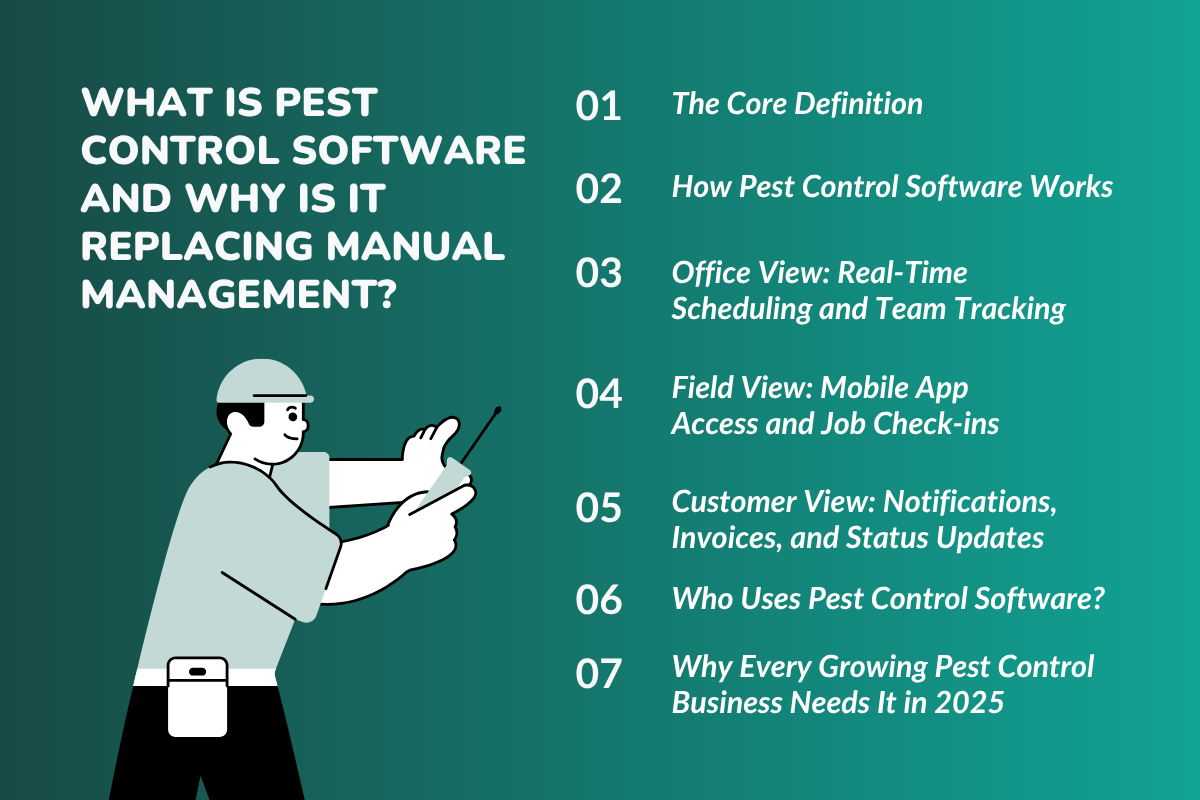
1. The Core Definition
At its core, pest control software is a cloud-based business management platform that brings together scheduling, billing, technician tracking, and customer communication.
It eliminates the need for scattered spreadsheets and paper forms, replacing them with a single, centralized system that can be accessed from anywhere. For instance, a technician finishes a termite treatment in one neighborhood and is automatically assigned the next job, complete with route directions, service notes, and payment details, all through an app.
Meanwhile, the office can see live updates, issue invoices, and even send service confirmations to the client instantly. That’s the power of modern pest control business software.
2. How Pest Control Software Works
Here’s how it flows, in plain terms:
- Job Scheduling: The office creates a new service request and assigns it to a technician who is available.
- Route Assignment: The system suggests the most efficient route using built-in route optimization.
- Work Order Completion: Technicians access the job details, perform the service, and add notes or photos.
- Payment & Invoicing: Once done, they can generate invoices and accept online payments right from the field.
- Follow-Up: Automated reminders are sent for re-treatments, feedback, or maintenance visits.
It’s a simple process that saves time, reduces manual errors, and ensures smoother office operations.
3. Office View: Real-Time Scheduling and Team Tracking
For managers, pest control management software offers a live view of all active jobs, technician locations, and upcoming appointments.
You can easily drag and drop jobs on a digital calendar, monitor field progress, and identify bottlenecks instantly. It replaces hours of phone calls with a visual dashboard that updates automatically.
4. Field View: Mobile App Access and Job Check-ins
Technicians can log into the pest control service software app from their smartphones. They receive detailed instructions, client information, and treatment notes on the go.
With digital check-ins and photo uploads, they can complete their work efficiently and sync updates back to the office in real time. No paperwork. No delays.
5. Customer View: Notifications, Invoices, and Status Updates
Clients also benefit from this ecosystem. Through a customer portal, they receive service reminders, invoices, and real-time updates when a technician is en route.
This level of transparency enables pest control companies to deliver unparalleled customer experiences, building trust and loyalty with every visit.
6. Who Uses Pest Control Software?
This software isn’t just for big franchises. It’s designed for:
- Small local pest control businesses looking to grow and save time: These teams benefit from automation that simplifies scheduling, billing, and follow-ups, allowing them to focus more on customer service and new leads.
- Franchise owners managing multiple locations and teams: They can monitor performance, allocate resources, and maintain consistent service quality across all branches from a single dashboard.
- Technicians who need quick access to jobs, maps, and client info in the field: With mobile access, they can update job status, upload photos, and process payments instantly, reducing paperwork and delays.
Whether you’re a one-van operation or a regional service network, pest control business software scales with you.
7. Why Every Growing Pest Control Business Needs It in 2025
Spreadsheets, whiteboards, and paper logs were once practical, but they can’t keep up with today’s demand for real-time accuracy and speed. Every missed appointment or delayed invoice translates into lost revenue and frustrated clients.
With pest control scheduling software, you can automate routine tasks, track technician performance, and provide instant responses to customer needs.
It’s not just about saving time; it’s about gaining visibility, improving coordination, and building a business that scales without chaos, for more information on automation in pest control software: Automating Pest Service Follow-Ups for Better Retention.
How Pest Control Software Transforms Daily Operations
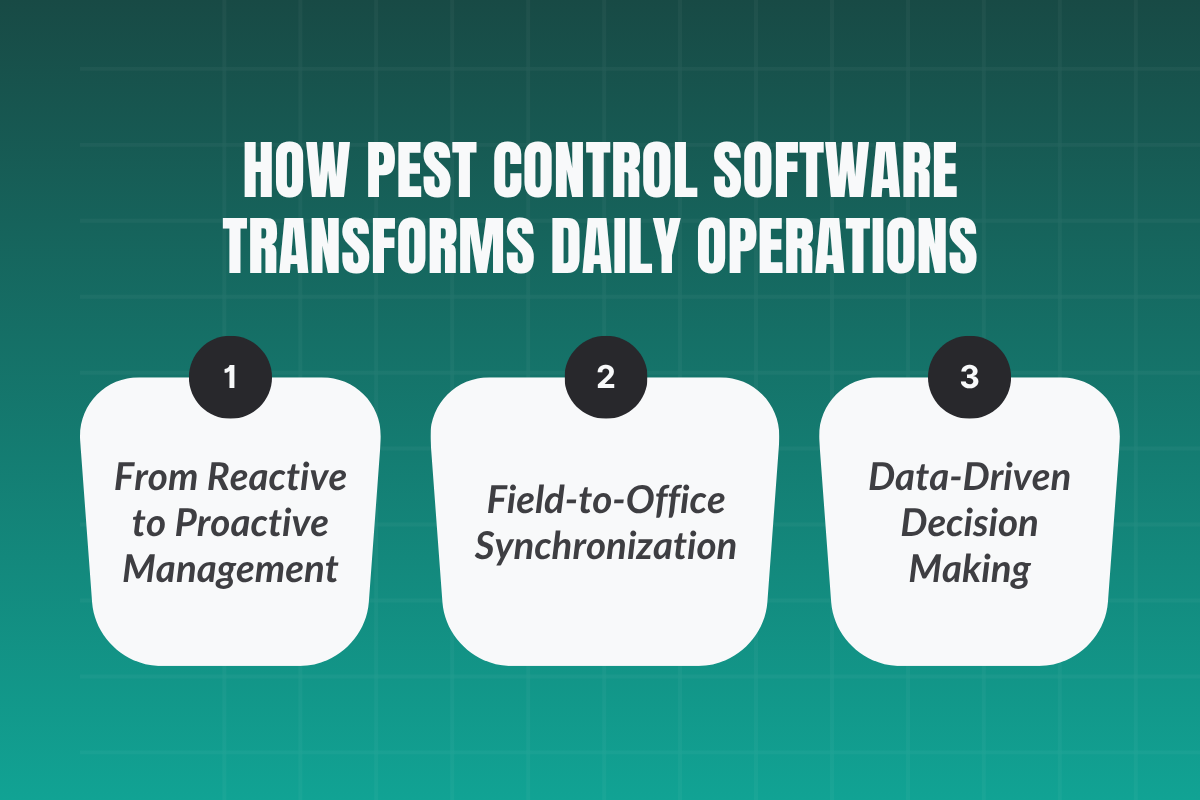
Pest control software doesn’t just digitize your workflow; it completely reshapes how your team operates. Here’s how it turns daily operations into a smoother, smarter, and more proactive system.
From Reactive to Proactive Management
Before software, most businesses operated reactively, waiting for issues to pop up before addressing them. With automation, you can now spot problems early. The system alerts you when follow-ups are due, detects scheduling conflicts, and flags missed invoices. You stay one step ahead instead of playing catch-up.
Field-to-Office Synchronization
With mobile-first pest control management software, technicians and office teams work as one. As soon as a job is completed in the field, the status updates in real time for the office to review. This reduces communication gaps and prevents mistakes such as double-booking or forgotten visits.
Data-Driven Decision Making
Over time, software collects valuable real-time data about your business's peak seasons, most requested services, and high-performing technicians. This enables managers to make informed decisions, allocate resources effectively, and forecast future growth more accurately.
What Are the Top Features of Pest Control Software You’ll Actually Use

Managing a pest control business involves constant juggling of schedules, payments, and customer updates. Pest control software streamlines the process with tools such as automated scheduling, digital work orders, and real-time reporting.
Here’s a quick look at the key features that make it essential for modern pest control companies.
1. Automated Scheduling and Route Optimization
Assigning technicians manually can waste hours every week. The best pest control routing software automates this by matching the right technician to the right job based on skill, location, and availability.
It also calculates the most efficient route, cutting down drive time, fuel costs, and delays. For multi-stop service days, this feature alone can boost productivity by 20–30%.
2. Digital Work Orders and Service Tracking
Forget paper forms, technicians now access digital work orders that include job details, previous treatments, and client preferences.
They can upload photos, log notes, and mark jobs as complete, all while syncing updates instantly to the office. This creates a digital record of completed work, enhancing accountability and reducing unnecessary back-and-forth communication.
3. Billing, Invoicing, and Payment Automation
One of the biggest challenges in the pest control industry is receiving payment more quickly. Modern pest control management software automates invoicing and supports instant online payments via cards or digital wallets.
That means no more chasing clients or losing track of unpaid bills. It also provides a clear view of cash flow in real-time.
4. CRM and Customer Management
Strong customer relationships are the foundation of repeat business. With built-in CRM tools, you can store customer information, treatment history, and service frequency in a single location.
Automated follow-ups, renewal reminders, and personalized offers help keep your brand top of mind, leading to more reviews and referrals over time.
5. Reporting and Analytics
Good decisions come from good data. Advanced reporting tools in pest control software let you track everything from technician performance to recurring revenue.
You can spot trends, compare profitability across service zones, and even prepare compliance reports with a few clicks. This visibility turns gut feelings into data-backed strategy.
If you need help in choosing the best pest control software, take a look at this: What to Look For in Pest Control CRM Software.
What Are the Top Pest Control Software Tools You Should Explore
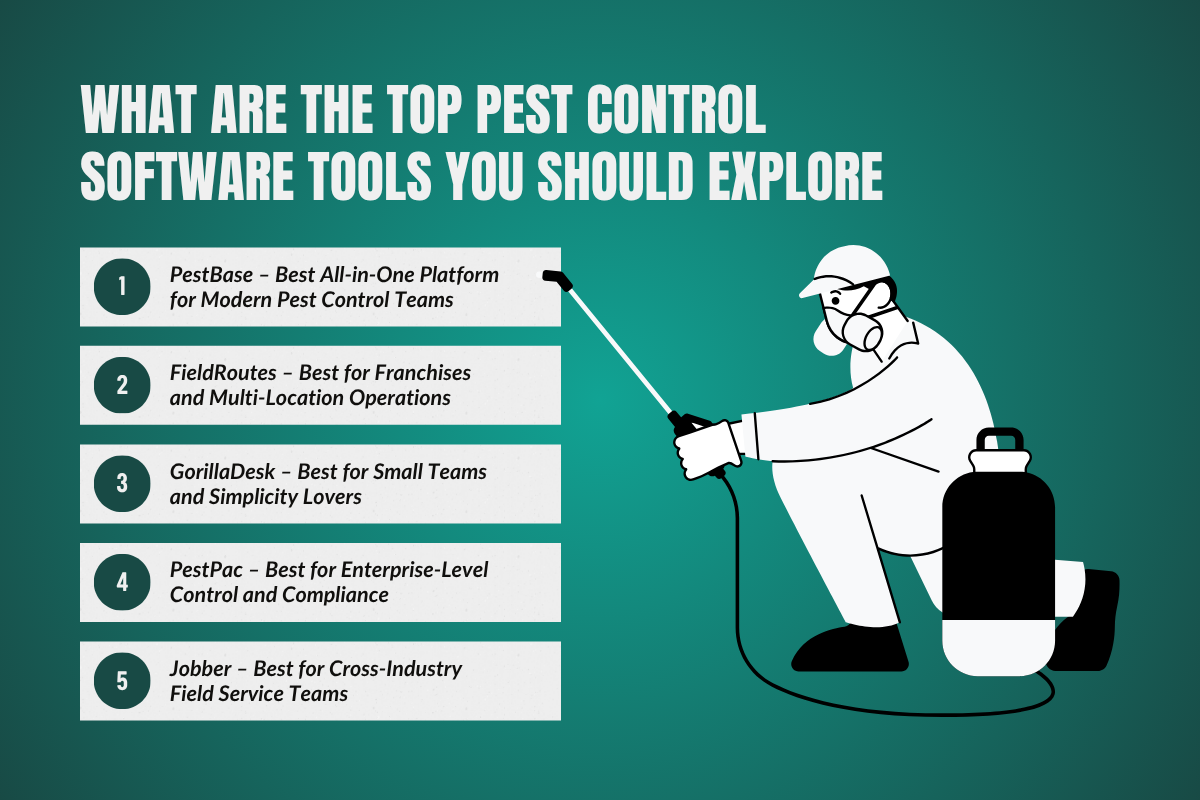
If you’re exploring your options, here are some leading pest control software tools to consider:
1. PestBase – Best All-in-One Platform for Modern Pest Control Teams
PestBase is specifically designed for pest control companies seeking an all-in-one system with a minimal learning curve. It combines scheduling, invoicing, CRM, and real-time updates into a single, easy-to-use dashboard.
The software stands out for its automation, which includes auto-assigned jobs, optimized routes, and instant invoice sending. With tools for both field and office teams, PestBase offers a balance of simplicity and power, helping growing businesses save time and stay organized.
Ideal for: Small to mid-sized pest control businesses ready to scale.
Key Strengths:
- Lead Capture & CRM: Automatically logs leads from forms, calls, and canvassing, and assigns them to reps, eliminating manual entry.
- Smart Scheduling & Dispatch: Offers drag-and-drop job scheduling combined with route optimization to reduce drive time and missed appointments.
- Field Technician Mobile App: Allows technicians to access jobs, upload photos, gather e-signatures, and complete service details right from their phone.
- Billing & Payment Automation: Enables instant invoicing and online payments after job completion, streamlining cash flow.
- Inventory & Compliance Tracking: Tracks chemicals and supplies, logs usage per job, and helps meet regulatory requirements, all in one platform.
- Marketing & Follow-Up Automation: Handles auto-reminders, upsell campaigns, and review requests, ensuring your team stays engaged with customers with minimal effort.
Pricing: PestBase does not list public pricing. You can request a demo or quote from their official site.
2. FieldRoutes – Best for Franchises and Multi-Location Operations
PestRoutes focuses on scalability and operational control. It’s built for
enterprises managing high volumes of jobs across different territories.
Its strengths lie in data management, routing, and reporting, making it a go-to for companies that want precision and control across large service zones.
Ideal for: Large pest control companies with multiple teams or regions.
Key Strengths:
- Route Optimization: FieldRoutes uses smart routing algorithms to automatically map the most efficient path for your technicians.
- Live Scheduling & Dispatch: The platform provides real-time visibility into tech availability, job status, and route progress. With a simple drag-and-drop scheduler, dispatchers can assign, reassign, or update jobs instantly.
- Automation: FieldRoutes automates repetitive tasks like scheduling recurring services, sending appointment reminders, generating invoices, and following up on unpaid bills.
- Customer & Field Tools: Technicians get a dedicated mobile app that includes job details, customer history, routing info, and the ability to record updates or process payments onsite.
- Compliance & Data Control: FieldRoutes offers secure data storage, easy data exports, and reporting tools designed to meet compliance requirements for various industries.
- Scalability: FieldRoutes is designed to grow with your business. You can add new routes, new service areas, and new technician teams without overwhelming your system.
Pricing: FieldRoutes offers two main packages: Growth (ideal for small businesses) and Corporate (for scaling operations). Both packages require you to “Request Pricing”; the specific monthly or per-user fees are not publicly listed.
3. GorillaDesk – Best for Small Teams and Simplicity Lovers
If you want software that’s
powerful but easy to use, GorillaDesk fits perfectly. It’s known for its clean interface and mobile-first design, allowing technicians to complete jobs, upload photos, and send invoices directly from their phones. It doesn’t overwhelm users with features; everything feels intuitive and quick to set up.
Ideal for: Independent operators and smaller pest control companies.
Key Strengths:
- Easy to Use: GorillaDesk is designed with a clean, intuitive interface that’s easy for small teams to learn. Even new users can get fully onboarded quickly without heavy training.
- Smart Scheduling & Routing: The platform includes drag-and-drop scheduling, real-time calendar visibility, and optimized route planning to reduce drive time.
- Digital Work Orders: Technicians can update job status, upload photos, add notes, and record materials directly from the field.
- Built-In Billing & Payments: GorillaDesk makes billing seamless with digital invoices, automated reminders, and online payment options.
- Pest-Specific Tools: For pest control businesses, the software includes essential industry features such as chemical use tracking, regulatory compliance logs, and detailed treatment records.
Pricing: Our single plan, with unlimited admin users, is ideal for growing teams. The plan starts at a basic $49 per month, pro $99 per month, and growth $299 per month.
(Source: GetApp)
4. PestPac – Best for Enterprise-Level Control and Compliance
PestPac has long been a leader in pest control management software for big organizations. It goes beyond basic scheduling and invoicing to include compliance reporting, multi-branch analytics, and workflow customization. It’s feature-heavy but powerful for teams that need enterprise-level control and detailed oversight.
Ideal for: Large pest control enterprises with advanced reporting needs.
Key Strengths:
- End-to-End Operations Control: Unified platform for scheduling, dispatch, billing, and CRM.
- Advanced Reporting & Analytics: Over 100 built-in forms and dashboards for financial, operational, and compliance insights.
- Mobile Field Access: Technicians use mobile apps for job details, signatures, photos, and real-time updates.
- Robust CRM and Lead Management: Designed specifically for pest control with tools for leads, opportunities, service tracking, and retention.
- Commercial & Multi-Location Support: Handles complex accounts, multi-unit properties, and scaling across service zones.
- Integrated Billing & Payment Automation: Built-in accounting features streamline invoicing, online payments, and revenue tracking.
Pricing: PestPac offers three tiered plans: Emerging, Growing, and Enterprise. The pricing is custom/ quote-based — you must contact WorkWave for an exact figure.
5. Jobber – Best for Cross-Industry Field Service Teams
Jobber isn’t explicitly designed for pest control, but it’s popular among field service professionals. Its flexible tools for scheduling, dispatching, and invoicing make it suitable for pest control teams that need reliable basics without the complexity of enterprise systems.
Ideal for: Field service businesses that include pest control among other trades.
Key Strengths:
- Unified Scheduling & Dispatch: Drag-and-drop calendar with real-time updates to keep jobs organised.
- Smooth Invoicing & Payments: Instant quotes, digital invoices, and online payments for faster cash flow.
- Mobile Field Access: Technicians use the mobile app to access job info, check in, and update status on the go.
- Client Relationship Tools: Built-in CRM, follow-ups, and client communications help boost retention and referrals.
- Easy Integrations & Automations: Connects with QuickBooks and Zapier, supporting automation to reduce administrative work.
- Affordable for Small Teams: Designed for small to medium service businesses with transparent pricing and quick setup.
Pricing: Transparent, tiered pricing core plan: $29-$39/month, connect plan for teams: $129/month (billed annually), grow plan for teams $249/month(billed annually), plus for teams $449/month (billed annually).
Choosing the Right Pest Control Software for Your Business
Choosing the right pest control software can make or break your operations. Here’s how to evaluate your options, avoid common pitfalls, and ensure you’re investing in a platform that truly delivers ROI.
> Key Evaluation Criteria
When evaluating software solutions, look for:
- A clean, user-friendly interface and easy onboarding.
- Strong mobile compatibility for field use.
- Integration with invoicing, CRM, and payment systems.
- Scalability to handle new teams, commercial accounts, and multiple locations.
- Reliable customer support and regular updates.
> Common Mistakes to Avoid
- Choosing generic field service software that lacks pest-specific tools.
- Ignoring mobile access is a must-have for technicians on the road.
- Overlooking automation and analytics, which drive efficiency and profitability.
> Questions to Ask Before Buying
- Can it manage recurring pest treatments and service contracts?
- Does it offer real-time tracking for technicians and vehicles?
- What kind of reporting and compliance tools are included?
- Is there a free demo to test before committing?
The Real ROI of Pest Control Software
Most business owners ask the same question: Is it really worth it? The answer is yes. The return on investment comes from three key areas:
- Time Saved: Automating scheduling, invoicing, and reporting frees up approximately 1 hour per week.
- Revenue Growth: More efficient operations mean more completed jobs and more customers served per day.
- Customer Retention: Faster responses, clearer communication, and transparent billing foster trust that leads to repeat business.
Over the course of a year, even a modest-sized pest control company can save thousands in labor costs and acquire dozens of new customers, all by running more efficient processes.
Future Trends in Pest Control Software 2025 and Beyond
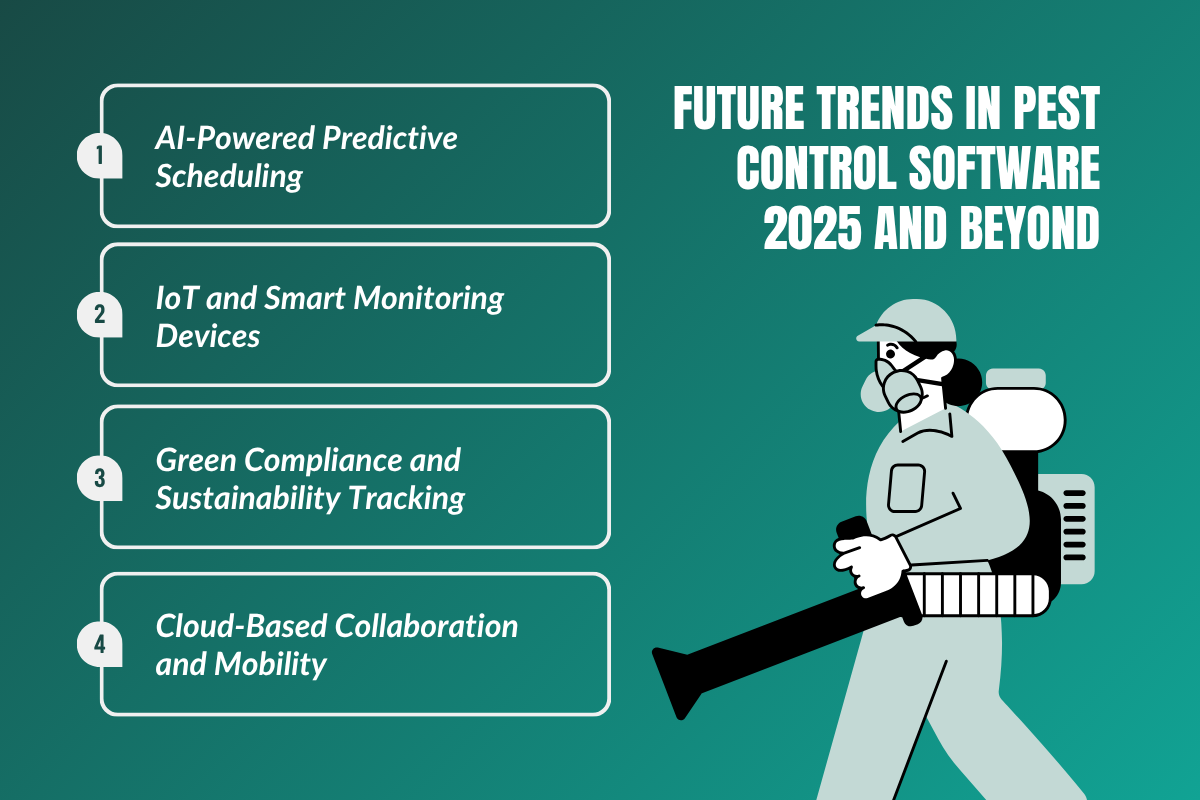
The pest control industry is evolving fast, and software is leading the charge. Here’s a look at the top technology trends shaping how pest control companies will operate in 2025 and beyond.
1. AI-Powered Predictive Scheduling
Software is becoming increasingly intelligent, capable of predicting high-demand seasons and automatically scheduling recurring treatments before customers even request them.
2. IoT and Smart Monitoring Devices
Next-gen platforms are integrating with smart traps and pest sensors that send real-time alerts when activity is detected, a game-changer for commercial clients.
3. Green Compliance and Sustainability Tracking
With eco-friendly pest control becoming the norm, software now helps track sustainable pesticide usage and automatically generate compliance reports.
4. Cloud-Based Collaboration and Mobility
Cloud access enables managers, technicians, and franchises to collaborate seamlessly regardless of their location.
Bringing It All Together
Pest control software isn’t just another tech upgrade; it’s the backbone of a modern, scalable pest control business. It simplifies operations, strengthens client relationships, and helps you make smarter decisions every day.
If your company is ready to trade paperwork and guesswork for precision and growth, it’s time to explore tools built specifically for this industry.
That’s where PestBase can help you. Built for pest control operators who want efficiency without complexity, PestBase combines automation, reporting, and team collaboration into a single, intuitive platform. It’s a software designed to help you manage more jobs, serve more customers, and increase sales, all while saving time.
Take Control of Your Pest Control Business with PestBase
Ready to modernize your pest control business? Try PestBase today and see how easy scheduling, invoicing, and customer management can be.
Schedule your demo today and get started. Reduce Admin Stress & Boost Technician Efficiency!
FAQ's
1. Is pest control software suitable for small businesses?
Absolutely. Even small pest control companies benefit from features like automated scheduling, route optimization, and easy invoicing. It saves time, reduces costs, and helps teams stay organized.
2. Can I track my technicians in real time?
Yes. Most pest control software, including PestBase, offers GPS tracking and live job updates so you always know where your technicians are and what stage of service they’re on.
3. How does pest control software improve customer satisfaction?
It enhances communication by sending automatic service reminders, technician ETAs, and digital invoices. Customers stay informed, which builds trust and leads to more repeat business.