January 16, 2026
If you’ve been in the industry long enough, this scenario might feel familiar: a new inquiry comes in, follow-ups are delayed, and customer details are scattered across notes and spreadsheets.
Technicians arrive on-site without complete job information, slowing down service and frustrating customers. Many companies assume these challenges come from limited staff or too many jobs. In reality, outdated systems are the real issue.
This makes a pest control CRM essential for pest control businesses that want to grow without losing leads or customer trust.
Pest Control CRM for Growing Businesses: Turn Enquiries into Long-Term Customers
Pest control CRM helps businesses streamline lead handling, improve follow-ups, and strengthen customer relationships. By centralizing enquiry tracking, scheduling, customer communications, and service history, teams gain better control over daily operations and reduce the risk of missed opportunities.
This software also supports faster responses, smoother coordination between office staff and pest control technicians, and easy access to past job details and customer preferences.
In short, pest control companies using modern CRM solutions can convert more enquiries, retain customers longer, improve operational efficiency, and create more predictable revenue, making CRM an essential tool for scaling successfully in the pest control industry. Now in this guide, we'll explore how CRM-driven workflows help convert more leads and build long-term customer relationships.
Key Takeaways
- CRM software for pest control companies helps prevent lead loss by improving response times and ensuring consistent follow-up.
- Centralized customer and job data improves coordination between office teams and pest control technicians.
- Automated workflows support higher enquiry-to-customer conversion rates
- Better visibility into pest control operations helps businesses scale without added complexity
- CRM-driven processes strengthen customer relationships and increase long-term retention
Ready to put these insights into action? Book a demo to experience how CRM-driven workflows support faster growth and smoother coordination across your pest control business.
Why Pest Control Leads Slip Away Without a CRM?
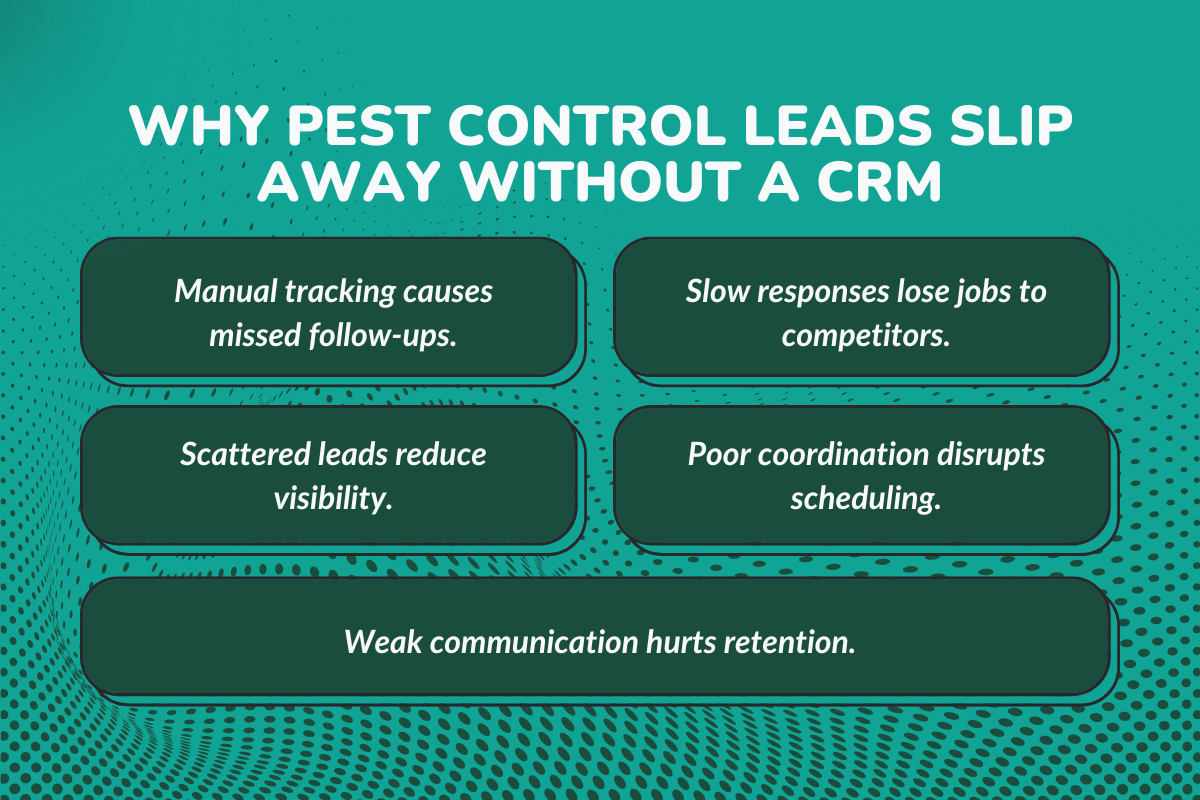
For a growing pest control business, leads drive every opportunity. When tracking, follow-ups, and scheduling rely on manual processes, enquiries are easy to miss, especially during peak seasons.
This is where the absence of pest control business starts to impact conversions, customer trust, and even long-term cash flow.
1. Missed Follow-Ups and Slow Response Times
In a competitive pest control company environment, speed matters. Customers expect quick replies, clear communication, and professional handling from the very first interaction.
A. Manual lead handling increases the risk of lost enquiries
When leads come in through phone calls, websites, ads, or referrals, managing them manually makes tracking extremely difficult.
Without a centralized system, lead information quickly becomes scattered and difficult to manage.
- Enquiries from multiple channels are hard to track without field service management software.
- Busy schedules prevent office teams from consistently updating lead statuses.
- Missed callbacks directly affect the customer lifecycle, from first contact to repeat service.
Without automation and visibility, even skilled pest control technicians may never hear about high-intent leads that could be turned into booked jobs.
B. Delayed responses reduce trust and conversion.
In the pest control business, response time often decides who wins the job. When potential customers reach out, they’re usually dealing with an urgent issue and expect quick reassurance.
If responses are slow or inconsistent, confidence drops, and the enquiry moves on to a faster competitor.
- Customers typically contact multiple pest control companies simultaneously.
- Faster responders are perceived as more reliable and professional
- Quick follow-ups improve booking rates and support excellent customer service
This delay not only affects immediate conversions but also weakens the overall customer lifecycle and long-term cash flow.
2. Disconnected Teams and Scattered Information
When teams don’t work from the same system, visibility suffers. For a growing pest control business, disconnected tools make it harder to manage jobs, people, and customers smoothly, especially as operations scale.
A. No single system for lead and job visibility
Without a unified view, sales and operations teams struggle to stay aligned throughout the scheduling process.
When lead and job data live in multiple places, coordination breaks down.
- Sales teams lack real-time clarity on pest control technicians’ availability.
- Job details are spread across spreadsheets instead of a centralized pest control management software.
- Limited visibility slows down pest control scheduling software and route optimization decisions.
This fragmentation affects the efficiency of the entire business and limits the value of critical data needed for planning and reporting.
B. Inconsistent communication impacts customer confidence.
When information isn’t shared consistently, customers notice the gaps quickly. Disjointed updates create uncertainty and weaken trust.
- Mixed messaging across calls, emails, and the customer portal creates confusion.
- Poor coordination delays responses and lowers close rates
- Inconsistent follow-ups hurt excellent customer service and long-term customer lifecycle value
Using connected field service management software brings teams, data, and communication together, helping pest control companies stay organized, responsive, and credible.
A clear example of this transition toward smarter operations is explored in the blog: Why Pest Control Companies Need a CRM.
Converting More Enquiries Into Leads Using Pest Control CRM
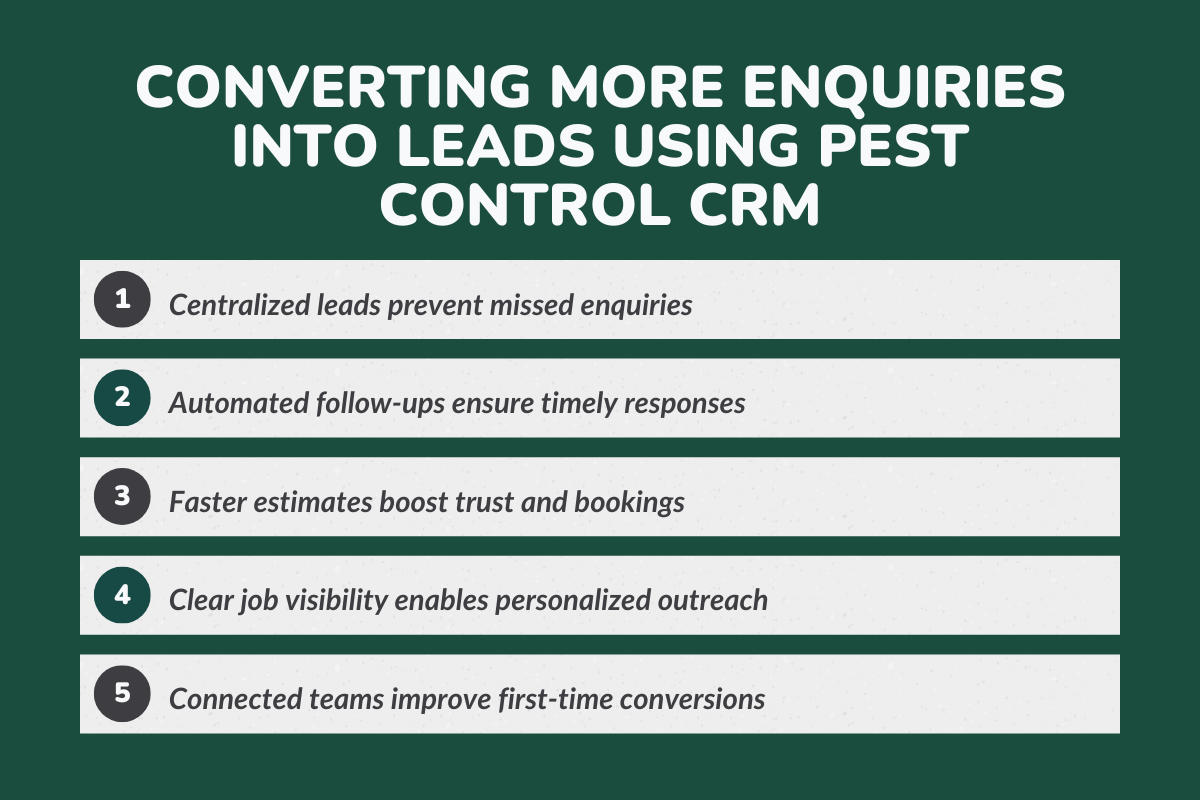
Once enquiries are captured correctly, the next challenge is turning them into confirmed jobs. A pest control CRM helps businesses respond faster, stay organized, and deliver a consistent experience that builds confidence from the first interaction.
1. Structured Lead Capture and Follow-Up Automation
A CRM brings every enquiry into one system, ensuring no lead is missed or forgotten. With automation in place, follow-ups happen on time and without manual effort.
- Automatic lead assignment routes enquires to the right team instantly
- Built-in reminders ensure timely callbacks and consistent follow-ups
- Centralized communication supports excellent customer service across channels
This structured approach improves lead handling while supporting the broader scheduling process and customer lifecycle.
2. Improving First-Time Customer Conversions
Speed and relevance play a significant role in converting first-time enquiries into paying customers.
Better visibility allows teams to respond quickly and communicate with purpose. This also facilitates:
- Faster estimates and responses increase trust and booking rates
- Clear job visibility helps personalize outreach based on customer needs
- Connected data improves coordination between sales teams and pest control technicians
By using pest control management software with CRM capabilities, businesses gain the clarity and responsiveness needed to convert more enquiries into long-term customers.
How Pest Control CRM Enhances Customer Experience?
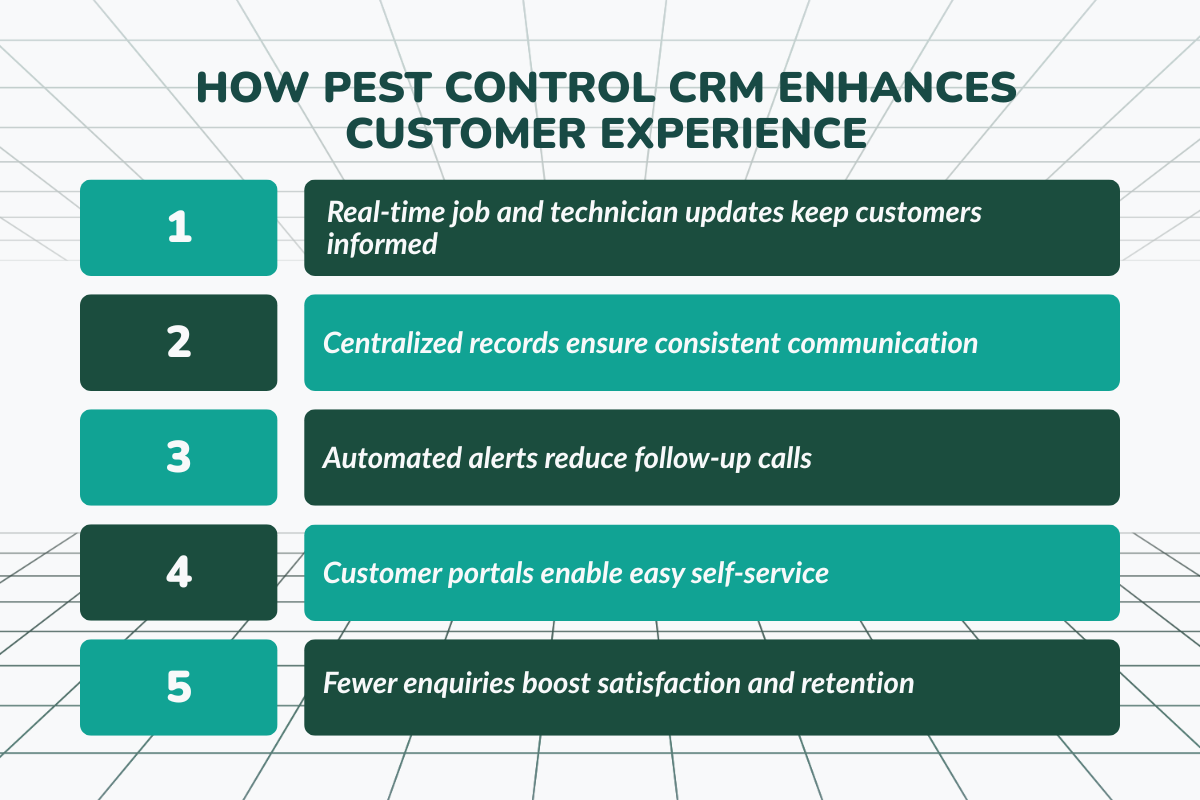
A well-implemented CRM turns every customer interaction into a seamless, informed, and satisfying experience.
1. Improving Transparency and Communication
One of the biggest frustrations for customers is not knowing what’s happening. When they can see job updates, schedules, and service details in real time, there’s far less confusion and far fewer follow-up calls asking for status updates.
- Real-time job status and technician updates help eliminate uncertainty
- Centralized service records keep past visits and conversations easy to reference
- Automated alerts keep customers informed at every step without manual follow-ups
2. Reducing Support Dependency
When customers can take care of simple requests on their own, they don’t need to reach out to support as often. A pest control CRM offers self-service options that let customers check service details, invoices, or payment status whenever they want.
Better visibility gives customers clarity and confidence throughout their service experience. This means:
- Customer portal access handles common requests without office calls
- On-demand visibility into services and payments lowers support load
- Fewer enquiries lead to higher satisfaction and stronger retention
Optimizing Daily Operations with Job Management
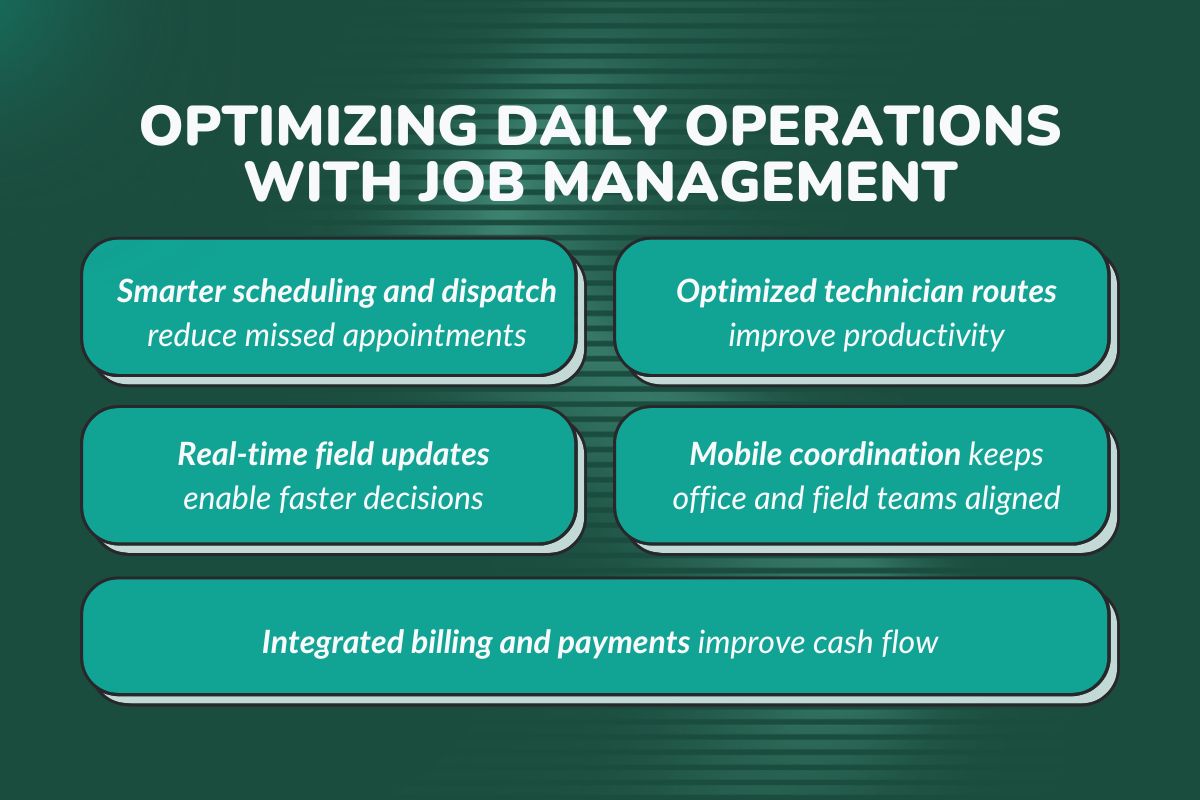
Efficient daily operations are critical for pest control companies aiming to scale. The right pest control business software streamlines workflows, improves field coordination, and ensures clients stay informed at every step.
1. Smarter Scheduling and Dispatch
Why it matters: Missed appointments and inefficient routes reduce productivity and client satisfaction.
This enables:
- Reduced scheduling conflicts and fewer missed appointments, improving day-to-day office efficiency
- Automated recurring service schedules that help maintain consistency and strengthen long-term client relationships
- Customer portal updates that keep clients informed, improving trust, retention, and overall service experience
2. Real-Time Field Updates
Why it matters: Accurate, up-to-date field information allows both office and field teams to respond faster, make better decisions, and avoid costly missteps.
This enables:
- Real-time access to job status, notes, and updates for better job management and quicker decision-making
- Stronger coordination between office staff and field technicians through a mobile app that syncs data instantly
- Accurate tracking of chemical usage and application records to support compliance and reporting requirements
- Faster billing and payment processing by syncing completed job data with invoicing and online payment systems
3. Optimized Technician Routes
Why it matters: Inefficient routing wastes time, increases fuel costs, and limits how many jobs technicians can complete in a day.
This enables:
- Smarter route planning that reduces travel time and fuel expenses
- More jobs completed per technician without overloading schedules
- On-time arrivals that improve customer satisfaction and trust
- Faster response to urgent or same-day service requests through dynamic route adjustments
4. Integrated Billing and Payments
Why it matters: When billing is disconnected from job completion, invoices are delayed, payments are missed, and office teams spend unnecessary time reconciling work.
This enables:
- Automatic invoice creation as soon as a job is marked complete, eliminating manual follow-ups
- Faster payments by allowing customers to pay online immediately after the service is provided
- Real-time visibility into unpaid invoices linked directly to completed jobs
- Reduced administrative workload by syncing job data, billing, and payments in one workflow
This breakdown of door-to-door and inbound sales approaches is precisely what we cover in the blog: Comparing Pest Control Apps: Door-to-Door vs Inbound Sales.
Centralizing Operations Using Business Management Software
Centralizing your operations with the right pest control management platform turns scattered workflows into a streamlined system, helping pest control companies save time, reduce errors, and scale efficiently.
| Business Challenge | Before Centralization | After Centralization |
|---|---|---|
| Task Duplication | Same data entered in multiple systems, wasting time and increasing errors | Single data entry across workflows improves efficiency and accuracy |
| Error Handling | Issues discovered late, causing delays and frustrated clients | Errors flagged early, enabling quick resolution and better customer experience |
| Process Consistency | Teams follow different methods, causing confusion and delays | Standardized workflows ensure reliable service delivery across the entire company |
| Data Accuracy | High risk of outdated or incorrect information impacting decisions | Real-time, consistent data improves planning, reporting, and job management |
| Scalability | Processes break down as job volume grows | Centralized system scales seamlessly with business growth, supporting more customers and recurring services. |
Ensuring Compliance and Safety with Chemical Tracking
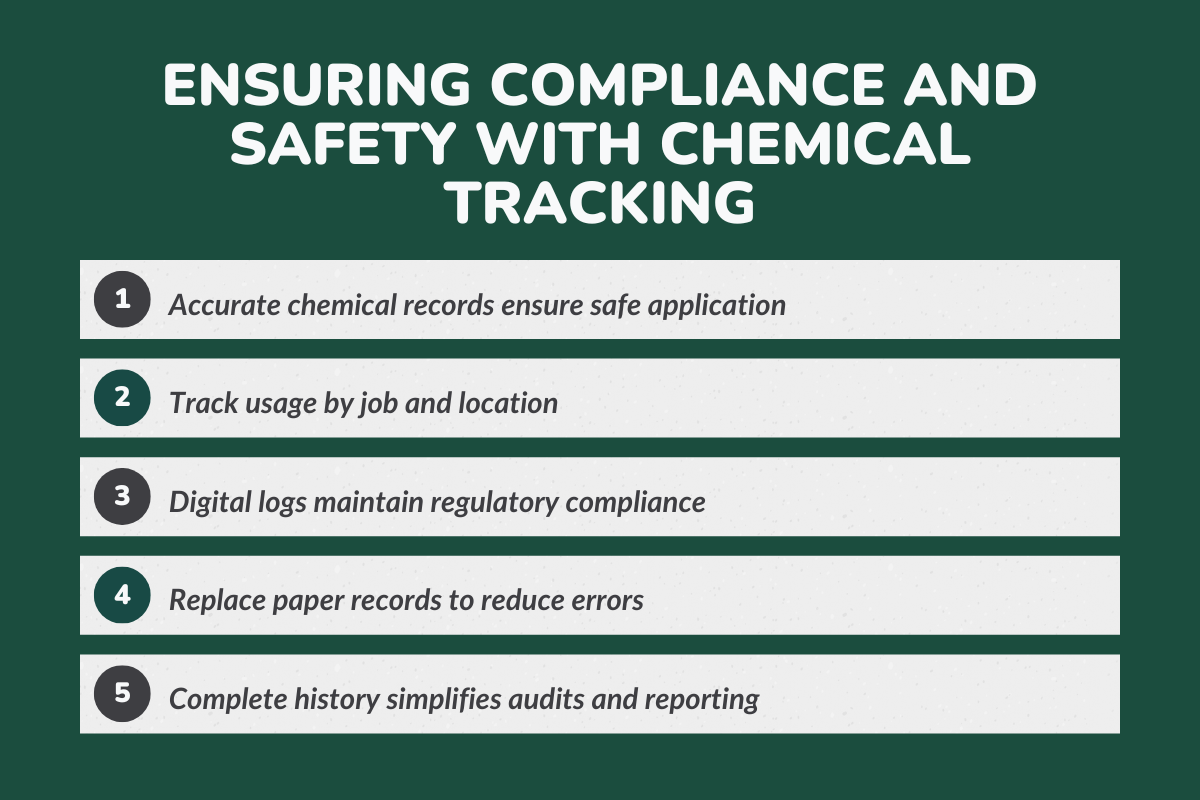
Keeping chemical usage accurate and well-documented is critical for pest control companies to ensure safety, meet regulatory requirements, and protect both employees and clients.
1. Accurate Chemical Usage Records
Clear and consistent records make it easier to track what’s used on every job and avoid compliance issues later.
A. Track Chemicals by Job and Location
Chemical usage is monitored for each job and location, providing full visibility and supporting efficient chemical tracking and inventory management.
B. Support Regulatory Compliance
All chemical records are stored in one place, making it easier to meet federal and state safety requirements. When inspections or reports are needed, everything is already documented and easy to access.
2. Minimizing Risk and Documentation Errors
Digital tracking helps eliminate common errors that happen with paper logs and manual entries. It keeps records consistent across the team, so nothing gets missed or recorded incorrectly.
A. Reduce Manual Mistakes
Paper logs are replaced with digital records, minimizing human errors in chemical handling and documentation.
B. Simplify Audits and Reporting
Historical chemical records are easily accessible, improving accountability and making audits straightforward across the entire company. Also, making them faster, clearer, and far less stressful for both office and field teams.
How Do Advanced Features Help Scale Your Pest Control Business?
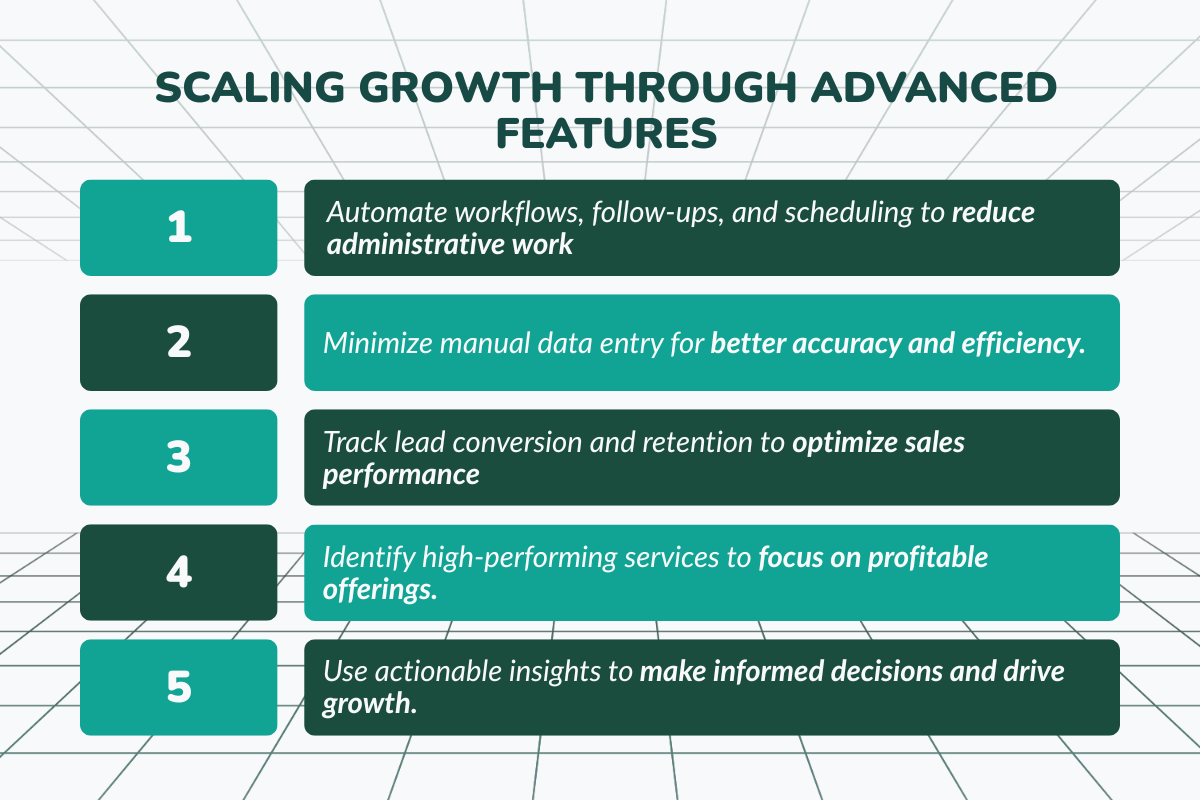
Leveraging advanced features in pest control business software allows companies to scale efficiently, reduce administrative burden, and gain actionable insights for more thoughtful decision-making.
1. Automation That Reduces Administrative Work
Automation takes repetitive, time-consuming tasks off your team’s plate, allowing them to focus more on customers and day-to-day operations that actually move the business forward.
A. Workflow Automation and Reminders
Tasks, follow-ups, and job schedules are automated, ensuring nothing falls through the cracks, improving overall office operations.
B. Less Manual Data Entry
By reducing duplicate data entry and manual processes, companies save time, improve data accuracy, and streamline operations across the entire company.
2. Performance Tracking and Insights
Data-driven insights help managers identify opportunities and make informed decisions for growth.
A. Monitor Lead Conversion and Retention
Tracking leads, conversion rates, and customer retention helps teams see how well inquiries turn into long-term customers. This makes it easier to improve follow-ups and build stronger relationships.
B. Identify High-Performing Services
Service performance data shows which offerings bring in the most value. With this insight, businesses can focus on profitable services, improve recurring plans, and make smarter decisions as they scale.
For an in-depth overview of the most effective software and platforms used by pest management teams today, read Best Digital Tools for Pest Management Teams in 2026.
How To Select the Best Pest Control Software for Your Business?
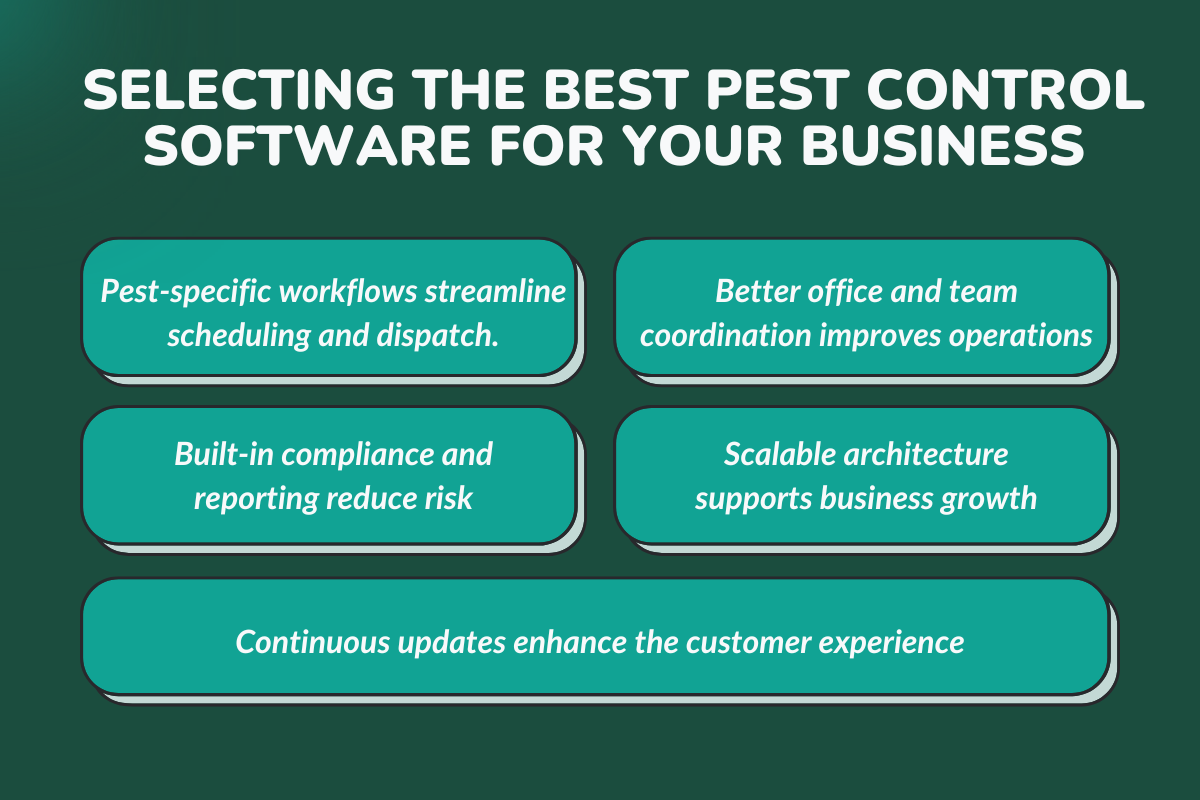
Choosing the right platform is a strategic decision that directly affects operational efficiency and customer experience. The right pest control solution supports both day-to-day execution and long-term growth.
1. Evaluating Industry-Specific Capabilities
Industry-specific functionality ensures the software aligns with real pest control workflows. This reduces the need for workarounds and improves consistency across office operations and field teams.
A. Pest-Focused Workflows
These workflows should reflect how pest control companies manage jobs, scheduling, and sales. Moreover, purpose-built processes improve efficiency and support a smoother sales process.
- It is designed for pest control scheduling, dispatch, and job tracking
- Supports structured office operations and team coordination
- Aligns service delivery with industry requirements
B. Built-In Compliance and Reporting
Compliance tools should be integrated, not added on. Built-in reporting reduces risk while keeping documentation accurate and accessible.
- The system supports federal and state compliance requirements by tracking and storing required records automatically.
- Automated reporting reduces manual effort and lowers the risk of errors during audits or inspections.
- All compliance records are centralized in one place, making audits and inspections faster and far less stressful.
2. Planning for Long-Term Growth
Growth-focused software should make it easier to scale. The right platform grows alongside the business, adapting smoothly as customer numbers increase, services expand, and teams get larger.
A. Scalable Architecture
Scalability ensures performance remains stable as operations grow. This is especially important for small businesses planning to expand.
- The platform supports growing teams and higher job volumes without slowing down daily operations.
- It adapts easily as service areas expand, helping businesses manage more locations and routes efficiently.
- Workflows remain efficient and organized even as scheduling, jobs, and customer data increase.
B. Ongoing Feature Updates
Regular enhancements help businesses stay competitive over time. This also means that continuous improvements support better customer engagement and marketing strategies.
- New tools and enhancements are added without disrupting daily operations or existing workflows.
- Customer portal features improve over time, making it easier to communicate and engage with clients.
- Continued updates support evolving marketing strategies and long-term business growth
Wrapping Up
Managing a pest control business without the right software creates unnecessary complexity, missed opportunities, and operational risk.
A dedicated pest control CRM and business management system centralizes data, improves responsiveness, maintains compliance, and delivers consistent customer experiences.
By investing in the best pest control software, businesses can streamline daily operations, empower field teams, and build a foundation for sustainable growth in an increasingly competitive market.
Every missed follow-up is a customer you never get back
Every delayed job update chips away at trust. But PestBase helps you stay organized, responsive, and one step ahead, without adding complexity. So, keep customers informed without extra effort. Run your pest control business with clarity and control.
See how PestBase makes it happen: schedule your demo now.
FAQs
1. What is pest control CRM software?
Pest control CRM software manages leads, customer information, and follow-ups in a single system, improving conversions and retention.
2. How does pest control software improve daily operations?
It centralizes scheduling, job management, and field updates, reducing manual work and improving coordination.
3. Is pest control software suitable for small businesses?
Yes, it supports small teams today and scales easily as the business grows.
4. How does chemical tracking help with compliance?
It records chemical usage by job and location, making compliance and audits easier.
5. Can pest control software improve customer experience?
Yes. Automated updates and customer portals keep customers informed and reduce follow-ups.
6. What should I look for in the best pest control software?
The best solution should also be user-friendly, scalable, and provide reporting and integrations to support business growth.