
November 13, 2025
It’s 8 p.m. You’ve just returned from a long day of field visits. The phone has finally stopped ringing, but your laptop is still open, half-filled invoices on one tab, unanswered customer messages on another, and next week’s schedule sitting unfinished.
You built your pest control business to serve customers, yet somehow, your evenings are spent chasing paperwork.
If that sounds familiar, you’re not alone. Most pest control owners wear too many hats: technician, accountant, dispatcher, and marketer, often at the expense of their time and peace of mind. But the truth is, it doesn’t have to stay that way.
How to Automate Your Business with Pest Control Business Management Software: A 2025 Guide
The pest control industry is growing fast. According to the NPMA 2024 Report, it expanded by nearly 8% last year. Yet, many small and mid-sized companies reported staff burnout and administrative overload. The real challenge isn’t finding customers; it’s managing the chaos that comes with success.
This guide will help you see how automation, through pest control business management software, can simplify operations, reduce stress, and give you back the time to focus on growth, not paperwork.
Key Takeaways
- Manual admin work consumes nearly 30% of pest control business time, reducing productivity and profits.
- Automation streamlines scheduling, payments, communication, and reporting into one efficient system.
- Smart scheduling tools save up to 10 hours a week by eliminating double bookings and delays.
- Automated invoicing speeds up payments and keeps cash flow consistent.
- Early adoption of pest control management software gives businesses a lasting competitive advantage.
What Is The Hidden Cost of Admin Overload
Every business owner has been there: you start the day with a plan, but the hours disappear into scheduling calls, rescheduling missed jobs, tracking payments, and checking in with technicians. Before you know it, the sun has set, and your “real work” hasn’t even started.
Data suggests that small business owners spend 20–30% of their daily hours on administrative tasks alone. In the pest control industry, this translates to lost service hours, delayed invoicing, and stressed teams.
The result?
- Missed or double-booked appointments
- Unsent invoices leading to cash flow gaps
- Lost customer records and poor follow-up
You didn’t start this business to drown in spreadsheets. You started it to help people live pest-free and to build something that runs smoothly. And for that, automation is how you reclaim that purpose.
What Exactly Is Pest Control Business Management Software?
Pest control management software is something like your digital office assistant, one that never takes a sick day, forgets a task, or misplaces an invoice.
It’s an all-in-one platform designed specifically for pest control companies to manage their day-to-day operations, from job scheduling and technician routing to customer communications, billing, reporting, and compliance tracking.
Unlike generic business management tools, pest control software understands your industry’s unique challenges:
- Recurring service visits
- Complex technician routes
- Seasonal pest patterns
- Compliance documentation
- Real-time customer updates
In essence, it brings every moving part of your business into one place.
Key capabilities include:
- Smart scheduling and route optimization
- Automated invoicing and online payments
- Customer portals for self-service
- Mobile apps for field technicians
- Real-time reporting and analytics
- Team management and internal communication
You can see it as an invisible office manager, quietly keeping your operations running while you focus on what truly matters, your customers.
How Automation Simplifies Your Operations
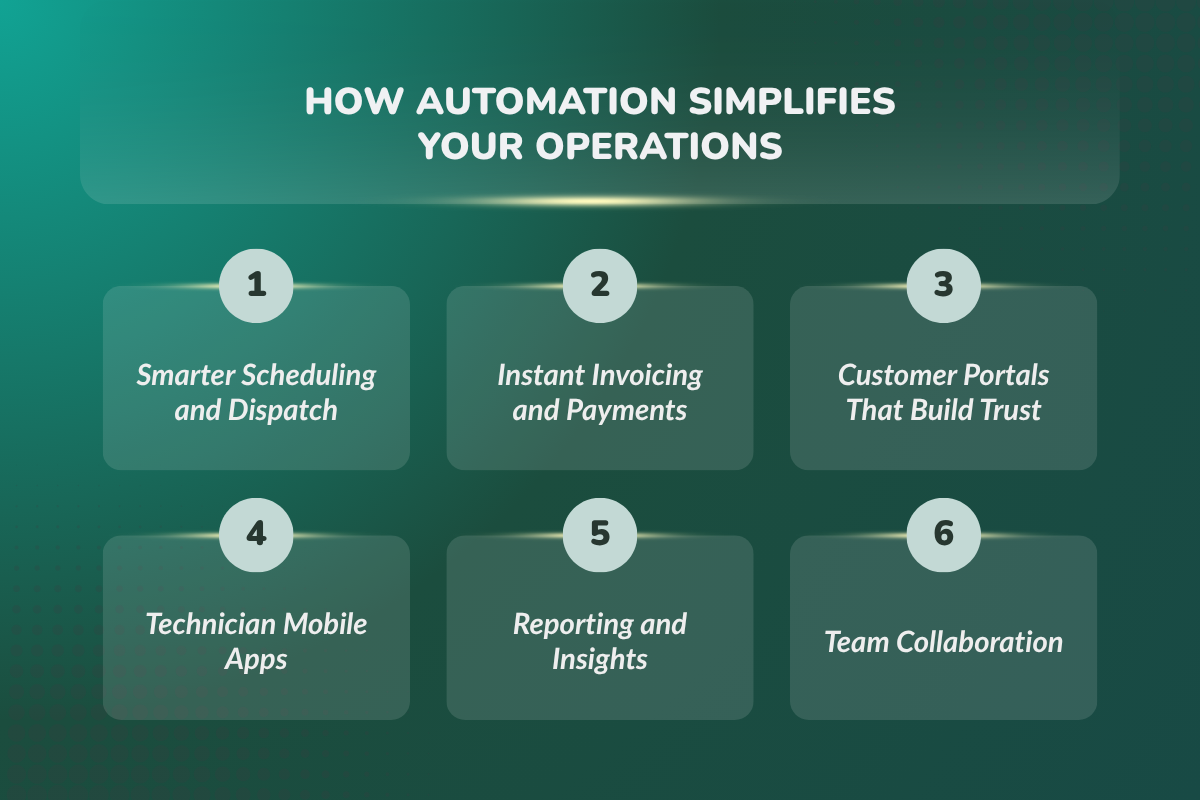
Let’s look at how automation changes the way pest control businesses function, feature by feature.
1. Smarter Scheduling and Dispatch
Before automation, scheduling often meant juggling calls, text messages, and Excel sheets. One technician gets double-booked, another misses a site, and customers grow frustrated.
With automated scheduling, jobs are instantly assigned based on technician availability, skill, and route proximity. The system syncs in real time with technician mobile apps, sending updates, reminders, and route maps automatically.
FieldRoutes reports that pest control companies using automated scheduling save up to 10 hours per week, reduce customer complaints, and increase team productivity by 15–20%. This doesn’t just mean fewer mistakes; it means smoother days, happier staff, and customers who feel valued.
2. Instant Invoicing and Payments
Delayed invoicing is one of the most common reasons small businesses face cash flow problems. The manual “I’ll do it later” approach usually turns into “I forgot to send it at all.”
Automation solves this. The moment a job is completed, the software generates an invoice, sends it to the customer, and syncs it with your accounting platform, such as QuickBooks or Xero.
You can also integrate digital payment options like credit cards or e-wallets, letting customers pay immediately after service. The outcome: predictable cash flow, faster payments, and zero missed invoices, all without adding administrative staff.
3. Customer Portals That Build Trust
In today’s market, customers expect transparency and control. A customer portal allows them to book appointments, view their service history, and make payments online.
Younger customers, aged 18 to 35, particularly value this convenience.
A PwC study showed that 73% of consumers consider experience as important as product quality.
When clients can log in anytime, track their service, and receive automated reminders, it builds confidence and loyalty. Happy customers not only stay; they refer others.
4. Technician Mobile Apps
Field technicians are the face of your business, but their time is often wasted on paperwork and back-and-forth communication. A technician app changes that.
It lets them update job status in real time, upload photos for documentation, record pest activity, and note materials used. The office instantly sees updates, allowing faster response to new bookings or customer follow-ups.
This eliminates miscommunication and reduces downtime between jobs. In simple terms, your field team becomes faster, more accountable, and better connected.
5. Reporting and Insights
Running your business based on guesswork can only go so far. Pest control management software provides a visual dashboard showing:
- Jobs completed
- Revenue trends
- Technician performance
- Customer retention rates
These insights help you identify what’s working and what isn’t. Instead of reacting to problems, you can make data-driven decisions that move your business forward. It’s not just about saving time; it’s about seeing clearly.
6. Team Collaboration
Communication gaps between the office and the field often lead to errors and frustration. With a shared system, everyone has access to the same information, job details, customer notes, and payment status, all in real time.
Teams stay organized, work gets done faster, and accountability improves naturally. Automation doesn’t replace your people; it empowers them to do their best work.
Take a deeper look at this: Automating Pest Service Follow-Ups for Better Retention
Top Pest Control Business Management Software in 2025
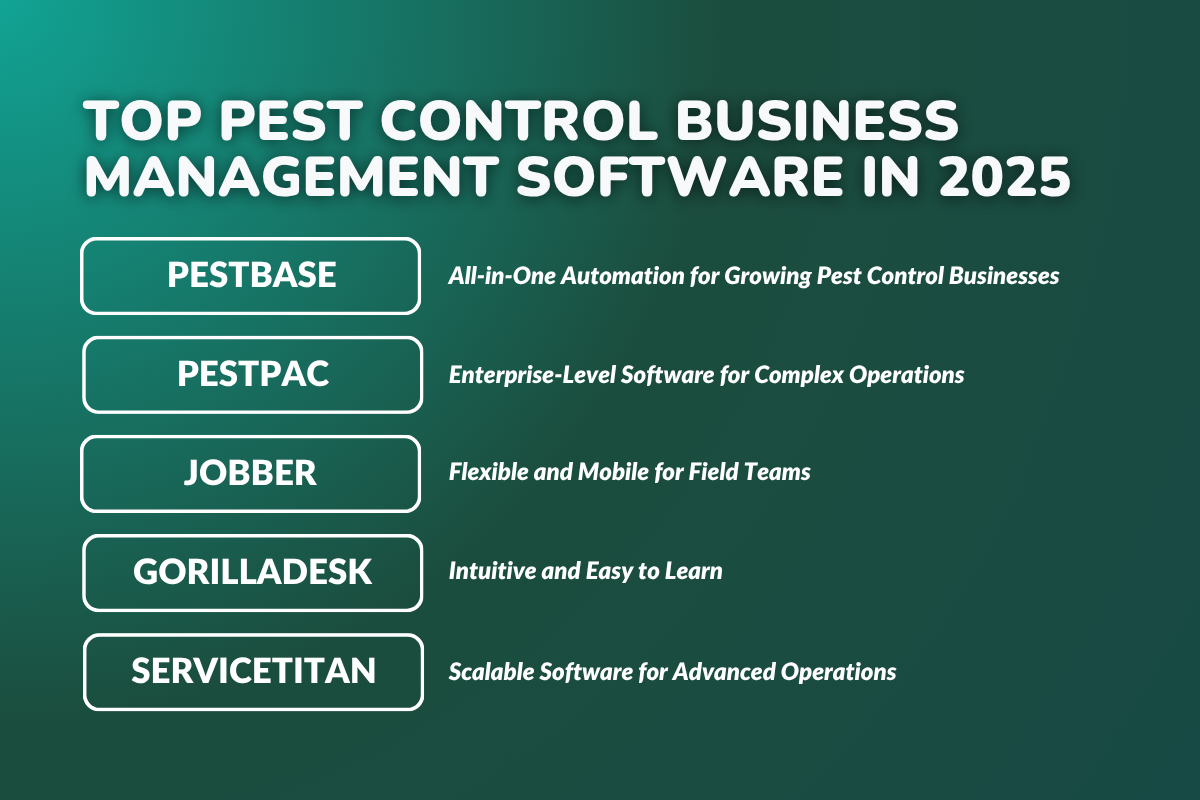
The pest control software market in 2025 is more competitive than ever, but that’s good news for you. Whether you’re a small local operator or a large enterprise managing multiple teams, the right pest control business management software can simplify every part of your workflow.
From smart scheduling to real-time reporting and route optimization, these tools turn hours of admin into just a few clicks. Below are the top software platforms leading the way this year:
1.PestBase – All-in-One Automation for Growing Pest Control Businesses
Ideal for: Small to medium-sized pest control companies that want to automate their daily operations without losing personal touch.
Key Features:
- Advanced pest control scheduling software that auto-assigns jobs based on technician location and availability.
- Pest control routing software that minimizes drive time and fuel costs.
- A built-in customer portal for online bookings, payments, and feedback, delivering unparalleled customer experiences.
- Real-time dashboards for pest control reporting, tracking job progress, and managing invoices.
- Automated marketing tools that bring more leads, new customers, and more customer reviews through reminders and follow-ups.
Why PestBase stands out:
PestBase is built specifically for pest control operators, not just generic field service management. It simplifies your processes, improves team efficiency, and helps you get paid faster, so you can focus more on growth, not paperwork.
Pricing: To obtain specific pricing details, a demo must be scheduled. Customer support suggests that pricing is tailored for small to medium–sized businesses; features include scheduling, billing, job tracking, automation, and growth-focused tools.
2. PestPac – Enterprise-Level Software for Complex Operations
Ideal for: Large pest control enterprises with multiple branches, technicians, and commercial accounts.
Key Features:
- Strong workflow automation and compliance management.
- Detailed analytics for real-time data tracking across teams and territories.
- Scalable CRM for managing the customer lifecycle across multiple locations.
- Enterprise billing and accounting integrations.
Why it works: PestPac is powerful for companies that need structured control and deep visibility into every part of their operation, from route optimization to revenue forecasting.
Pricing: Quote-based only; not publicly listed, must contact sales for a custom plan. Reports indicate costs can run high for small businesses, especially as modules/features are added. No free trial/demo follow-up reported.
3. Jobber – Flexible and Mobile for Field Teams
Ideal for: Small pest control and field service businesses that rely on on-the-go teams.
Key Features:
- Clean, user-friendly mobile interface for technicians.
- Smart scheduling and real-time updates.
- Built-in tools for invoicing and digital payments to help you get paid faster.
- Lightweight reporting and customer communication tracking.
Why it works: Jobber is simple, mobile-first, and perfect for teams who want to keep their tools light but effective.
Pricing (Monthly, as of mid/late 2025):
- Core: $29/month (annual)
- Connect Teams: $129/month (annual, 5 user)
- Grow Teams: $249/month (annual, 10 user)
- Plus: $449/month (annual, 15 users)
4. GorillaDesk – Intuitive and Easy to Learn
Ideal for: Small pest control operators looking for a quick setup and minimal training.
Key Features:
- Pest control service software that’s simple yet efficient.
- Integrated scheduling, invoicing, and route management.
- Mobile app for field updates and customer signatures.
- Reporting and client history tracking for better service delivery.
Why it works: GorillaDesk helps small businesses run their day-to-day smoothly without complexity, ideal for owners doing most of the heavy lifting themselves.
Pricing (Monthly):
- Basic: $49/month (flat-rate, unlimited users).
- Pro: From $99/month, includes extra features suitable for larger teams.
- Growth: $149/month
- Flexible pricing depending on the number of customers/users; 14-day free trial.
5. ServiceTitan – Scalable Software for Advanced Operations
Ideal for: Mid-to-large pest control companies expanding service areas or managing commercial accounts.
Key Features:
- Comprehensive field service management software with real-time job tracking.
- Deep reporting insights to optimize technician performance and route efficiency.
- Tools for marketing strategies, customer communication, and automated follow-ups.
- Integration with CRMs and accounting platforms for seamless office operations.
Why it works: ServiceTitan brings advanced analytics and automation to businesses that want to scale sustainably, reduce manual processes, and deliver a consistent customer experience.
Pricing: Not publicly listed. Pricing typically requires contacting ServiceTitan for a quote. It targets medium– to large-sized businesses that require deep features.
How to Choose the Right Software for Your Business
Choosing the right pest control business management software isn’t about picking a popular name; it’s about finding a system that fits how you work. The best software quietly runs the background tasks so you can focus on what matters: customers, field teams, and growth.
Here’s a quick guide to what to look for and what to avoid when comparing tools:
1. Pest control–specific workflows
Avoid generic CRMs. You need software designed for pest control operations, with job management, compliance tracking, and recurring service scheduling built in.
2. Cloud and mobile access
Your team spends more time on-site than in the office. A mobile, cloud-based system keeps technicians, customers, and office staff connected in real time.
3. Customer portals
A built-in customer portal improves transparency. Clients can book services, review reports, and pay online, enhancing the entire customer lifecycle.
4. Automation for admin tasks
Automation for scheduling, invoicing, and payment reminders saves hours weekly and ensures you get paid faster.
5. Data and reporting tools
Choose software that provides real-time data and pest control reporting dashboards so you can track routes, customer satisfaction, and team performance.
6. Free demo or trial period
Test it before committing. The right fit should feel intuitive, not complicated.
Pitfalls to Avoid:
- Paying for unnecessary features designed for other industries.
- Skipping staff training limits adoption and benefits.
- Using software that doesn’t integrate with accounting or payment tools.
| Feature | Priority |
|---|---|
| Pest control–specific workflows | Must-Have |
| Cloud and mobile access | Must-Have |
| Built-in customer portal | Must-Have |
| Automation for scheduling, invoicing, and reminders | Must-Have |
| Real-time reporting dashboard | Must-Have |
| Route optimization | Must-Have |
| Inventory management | Optional |
| Built-in marketing tools | Optional |
| Complex enterprise modules (for small businesses) | Avoid |
| Limited or no payment integration | Avoid |
If the software feels intuitive, helps your team save time, and reduces manual work, you’re on the right path.
Many modern solutions, like PestBase, focus on simplicity and automation, helping pest control businesses manage operations smoothly without extra layers of complexity.
How to Implement Pest Control Software Tools Without Disrupting Your Operations
Transitioning to new software doesn’t have to be complicated. A structured approach ensures smooth adoption without overwhelming your team.
1. Audit your pain points: Identify where your time is wasted, such as manual scheduling, late invoicing, or miscommunication.
2. Start small: Test the system with one team or service area.
3. Import your data: Most software, including PestBase, provides guided migration support.
4. Train your team: Short, focused sessions work best. The goal is comfort, not complexity.
5. Automate the repetitive tasks first: Begin with scheduling, invoicing, and payment reminders.
6. Monitor improvements: Track saved hours, faster payments, and improved customer satisfaction.
Don’t expect perfection from day one; expect measurable progress each week.
How to Win More Customers Through Smart Software: Beyond Admin Relief
While automation eases internal chaos, it also helps you attract and retain more customers. Today’s customers expect speed, transparency, and ease of communication. When you offer online booking, instant updates, and paperless billing, helps you stand out.
Software can automatically send appointment reminders, service follow-ups, and renewal prompts, keeping you in your customer’s mind without additional effort.
For example, PestBase users report shorter response times and higher renewal rates after customers begin using its online portal and automated communication tools.
Growth is no longer about working harder; it’s about working smarter, with tools that let you focus on customer relationships rather than repetitive tasks.
The Future of Pest Control in 2025 and Beyond
The pest control software market is projected to exceed $2 billion by 2027 (Verified Market Reports, 2025). The trend is clear: digital transformation isn’t optional anymore, it’s the foundation for growth.
Emerging trends include:
- AI-driven route optimization to minimize travel time and fuel costs
- Predictive analytics for customer insights and renewal forecasting
- Eco-friendly compliance tracking and digital record keeping
- Mobile-first service management for on-the-go efficiency
Businesses adopting these technologies early will lead the industry, setting standards for service quality and customer experience.
Conclusion: Take Back Your Time, One Click at a Time
You built your pest control business with hard work, long hours, and determination. But even the most dedicated owners need systems that support them. Pest control business management software isn’t about replacing people; it’s about removing friction so your people can shine.
No matter the size of your pest control business, investing in the right software means fewer errors, faster billing, and happier customers.
But if you’re looking for a tool designed exclusively for pest control operators, one that combines automation, reporting, routing, and customer communication into one intuitive platform, PestBase is where your digital transformation begins.
> You’ve done the heavy lifting; now let technology carry some of the weight.
About PestBase
If juggling calls, paperwork, and customer updates is holding your business back, PestBase, an all-in-one solution, simplifies it all. Whether you manage a small team or multiple service routes, PestBase grows with your business. Cut the admin clutter, boost your profits, and focus on what matters most: delivering reliable pest control services.
Get your custom walkthrough and see how automation can transform your workflow from chaos to control.
FAQs
1. What is pest control business software?
It’s an all-in-one tool that automates scheduling, invoicing, and customer communications, helping pest control operators manage jobs and office operations efficiently.
2. How does automation help pest control companies?
Automation saves time, reduces errors, and improves cash flow by optimizing routes, job management, and real-time reporting.
3. Why choose PestBase for your pest control business?
PestBase is software designed for pest control teams, offering scheduling, inventory management, and sales tools for commercial accounts and multiple locations.
4. Is PestBase good for small pest control or field service businesses?
Yes. PestBase gives small teams more flexibility to manage customers, payments, and jobs, all from one dashboard.
5. How does PestBase help increase sales and leads?
With marketing tools, automated follow-ups, and customer review tracking, PestBase helps attract potential customers and convert them faster.